
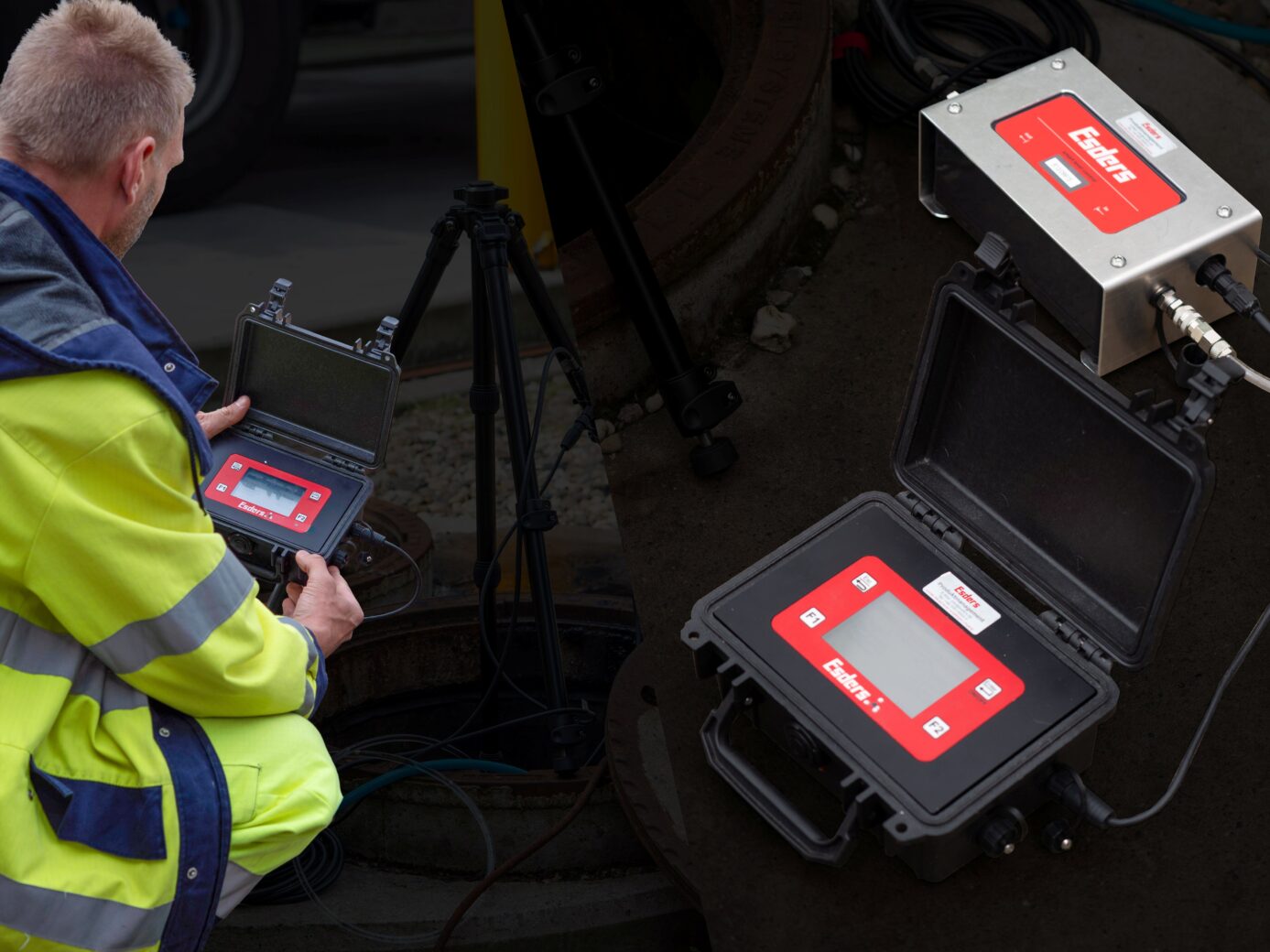
Tests on sewage, water, gas, district heating and fibre-optic networks: Simultaneous measurement and documentation
Depending on the task, different types of pipework, test media and regulatory frameworks must be taken into account. Whilst leak tests using air or water are the main focus in the wastewater sector, clearly defined pressure testing procedures are often required for supply pipelines. In addition, there are applications such as the testing of district heating pipes, speedpipes or borehole heat exchangers.
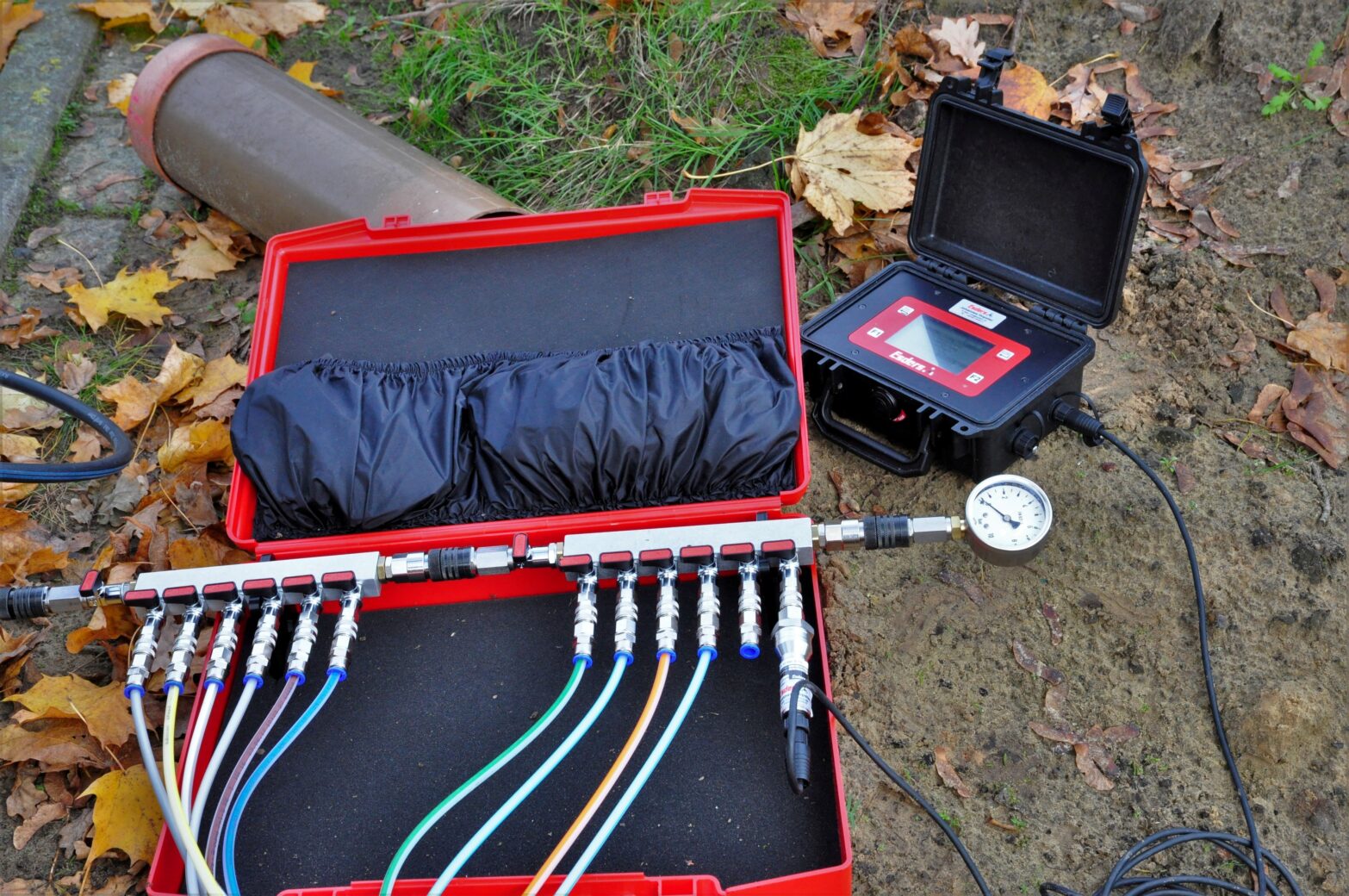
Test and measurement devices with integrated automated processes make this work easier. The tests that can be carried out using our device solution depend on the software options installed, the connected sensors and the accessories used.
The areas of application listed below clearly demonstrate just how versatile smart memo – an electronic pressure testing kit – is.
What tests can be carried out using the smart memo?
We will outline the most common tests carried out using our versatile pressure and leak testing device. You can find out more about the many other options available on the smart memo device here.
1. Leak testing of wastewater pipes and manholes in accordance with EN 1610 and DIN EN 805
Leak testing in the wastewater sector is one of the key applications of the smart memo. The “Wastewater EN 1610” option provides menu-guided test procedures for wastewater pipes, sewers and manholes. In addition to this standard, testing in accordance with DIN EN 805, DWA-A 139 and DWA-M 149-6 is also supported.
A choice can be made between two fundamentally different test procedures:
- Procedure A (air): Leak testing with air
- Procedure W (water): Leak testing with water
During the “Procedure A”, the pressure curve within the test object is monitored using a suitable pressure sensor. The smart memo guides the user through the individual test phases, records the measured values and documents the result.
An EDS2 level probe is used for the “Procedure W”. It measures the water level in the filled manhole or in a pipe connected to a manhole. If the level drops during the test, the change is recorded by the smart memo. Optionally, the smart level control can automatically maintain the water level whilst simultaneously measuring the volume of water supplied.
Pipe and manhole data can also be entered directly into the device. In the subsequent PDF test report, the test objects are displayed graphically along with the dimensions entered. This produces a clear and comprehensible report that brings together information on the test object, the measurement history and the result.
Request a consultation
Request a consultation regarding the DIN EN 1610 and DIN EN 805 options.
2. Regular leak testing of pressure sewer pipes using the HSA procedure
Pressure sewer pipes require testing not only before commissioning but also throughout their service life. Smart memo provides suitable test procedures for pipelines already in operation.
The “HSA Pressure Sewer Pipes” option includes two procedures developed by Augsburg University of Applied Sciences:
- HSA Standard Procedure
- HSA 20-Minute Test
The HSA Standard Procedure is intended for periodic leak tests on existing wastewater pressure sewer pipes. The abbreviated 20-minute test should only be used in exceptional cases and following consultation with the relevant water management authority.
With the appropriate accessories, the test procedures can be carried out fully automatically. Among other things, this requires a suitable motorised test pump, a sufficiently accurate pressure sensor, an EDS2 flow meter and an EDS2 automatic drain valve. The smart memo records and evaluates the relevant measurement data and generates the test report, which can be used as a standalone document or imported into the Bavarian State Office for the Environment’s Excel tool.
Request a consultation
Request a consultation on the HSA procedure options.
3. Leak test in accordance with DIN 1999-100 for separator systems
The leak test is a mandatory part of the general inspection of a separator system. It is carried out for the first time upon completion and subsequently at every periodic general inspection. In accordance with Annex A.6 of DIN 1999-100, it is conducted as a water loss test. For this purpose, the system is filled with water and the water level is monitored over a specified period.
The system or system component is deemed leak-tight if, after the test, the water level remains above the zero water level, taking into account a maximum permissible water loss of 500 ml per hour.
The test covers only the tank area. Inlet and outlet pipes should be tested separately in accordance with EN 1610.
Request a consultation
Request a consultation regarding the DIN 1999-100 option.
4. Pressure testing of drinking water pipes in accordance with DVGW W 400-2 and EN 805
Before a water pipeline is commissioned, it must be checked that the pipeline – including all fittings, joints, valves, etc. – has been constructed correctly and, as a structure, is watertight. The smart memo offers various regulatory-compliant options for pressure testing water pipelines.
For the DVGW worksheet W 400-2, the following test procedures, amongst others, are available:
- Contraction procedure
- Accelerated standard procedure
- Standard procedure
- Influence-minimised standard procedure
The smart memo guides the user through the test in an automated process, displays measured values and measurement trends, and saves the relevant test data. Further options are available, for example, for tests in accordance with EN 805, ÖVGW W 101 and SVGW W4.
An important part of the water pressure test is checking that there is no air present. If too much air remains in the pipe, it can mask leaks. The process of pigging is the solution for ensuring that there is no air in the pipe. For this purpose, the smart memo, in conjunction with the MPP2, offers an additional function that allows an early assessment of whether the subsequent pressure drop test might fail due to an excessively high air content.
In combination with a suitable motorised test pump and the EDS2 automatic drain valve, water pressure tests can also be largely automated. Pressure build-up, hold phases and the pressure drop test can then be controlled automatically by the smart memo.
Request a consultation
Request a consultation regarding the DVGW W 400-2 and DIN EN 805 options.
5. Pressure testing of gas pipes in accordance with DVGW G 469 and G 459-1
For gas pipelines, the smart memo supports various test procedures from the DVGW regulations. The DVGW G 469 B3 option allows users to carry out both the B3 pressure measurement procedure for gas distribution pipelines and the abbreviated pressure measurement procedure for gas network connection pipelines in accordance with DVGW G 459-1.
During the test, parameters such as test pressure, measurement duration and pressure curve are continuously recorded. The values are displayed on the device and subsequently automatically compiled into a test report. This means that measured values do not need to be transferred retrospectively from handwritten records into a report.
For the B3 pressure measurement procedure, the “Dynamic Pressure Test” function is also available. This helps to determine the required stabilisation phase based on the actual pressure curve.
The C3 procedure in accordance with DVGW G 469 can also be recorded using a dedicated option. However, for this procedure, the smart memo does not evaluate the pressure curve, as this evaluation is usually carried out by an expert. The recorded measurement data can subsequently be made available as an Excel spreadsheet via Esders Connect.
Request a consultation
Request a consultation regarding the DVGW G 469 and G 459-1 options.
6. Pressure testing of district heating pipes in accordance with AGFW FW 602
For newly laid district heating pipes, different pressure testing methods must be taken into account depending on the pipe and the test task. The AGFW FW 602 option provides four separate menu items in the smart memo for this purpose:
- Differential pressure measurement method using air
- Pressure measurement method using air
- Simultaneous pressure measurement method using air
- Water pressure test
The appropriate test sequence is selected on the device. The smart memo then guides the user through the individual test steps and records the measured values from the connected sensors.
This allows both air pressure tests and water pressure tests to be documented using a single device. The specific sensor and any additional accessories required depend on the selected method and the intended test pressure.
Request a consultation
Request a consultation regarding the AGFW FW 602 option.
7. Leak testing of speedpipes and fibre-optic protection conduits in accordance with ZTV TKNetz 40
Before fibre-optic cables are blown into a speedpipe, the integrity of the installed cable protection conduit can be checked by means of a pressure test. The smart memo offers a menu-guided test procedure for this purpose in accordance with ZTV TKNetz 40.
This software option supports the leak test of speedpipes and documents the pressure curve during the specified test procedure. Suitable pressure sensors, distribution strips and speedpipe adaptors, amongst other items, are available for connection.
The main advantage for contractors lies in the standardised procedure: the required test data is recorded directly on site and assigned to the relevant test object. Upon completion, digital evidence of the test carried out is available.
Request a consultation
Request a consultation regarding the ZTV TKNetz 40 option.
8. Pressure and leak testing of borehole heat exchangers
A dedicated software option is also available for borehole heat exchangers. The test sequence stored in the smart memo is based on the contraction method set out in EN 805. The adaptations to the specific conditions of borehole heat exchangers are based on the provisions of the Swiss standard SIA 384/6.
During the test, the smart memo continuously records the pressure and time curves. The measured values are stored and subsequently compiled into a test report. With the appropriate accessories, this test procedure can also be carried out automatically.
As specific requirements for testing borehole heat exchangers may depend on regional regulations, approvals and technical regulations, it should be clarified before the test is carried out which procedure is required for the project in question.
Request a consultation
Request a consultation regarding leak testing for borehole heat exchangers.
9. Freely programmable pressure tests and measurement data logging with EDS2 sensors
Not every test task follows a set of regulations already stored in the device. That is why the smart memo also features a freely programmable pressure test. Furthermore, the device can be used for customised measurement data logging with the optional EDS2 data logger.
The data logger allows measurement values from various EDS2 sensors to be recorded simultaneously. Sensors are supported for:
- Pressure
- Temperature
- Flow
- Level
Up to five sensors can be connected to the smart memo at the same time. The recording interval can be freely set within the available measurement duration. The stored data can then be exported as an Excel data set via Esders Connect. A PDF report with graphical measurement curves is also available.
This function is suitable for tasks where measured values need to be recorded over a specified period without the need for a fully pre-programmed test sequence.
Request a consultation
Request a consultation on the fully programmable tests.
.jpg?width=100)
Digital test reports and measurement data management
Regardless of the specific area of application, the results of a test must be documented in a way that allows them to be traced. The smart memo stores the measured values and, once the test is complete, generates a test report containing the object, project and tester details entered.
For monitoring on the go
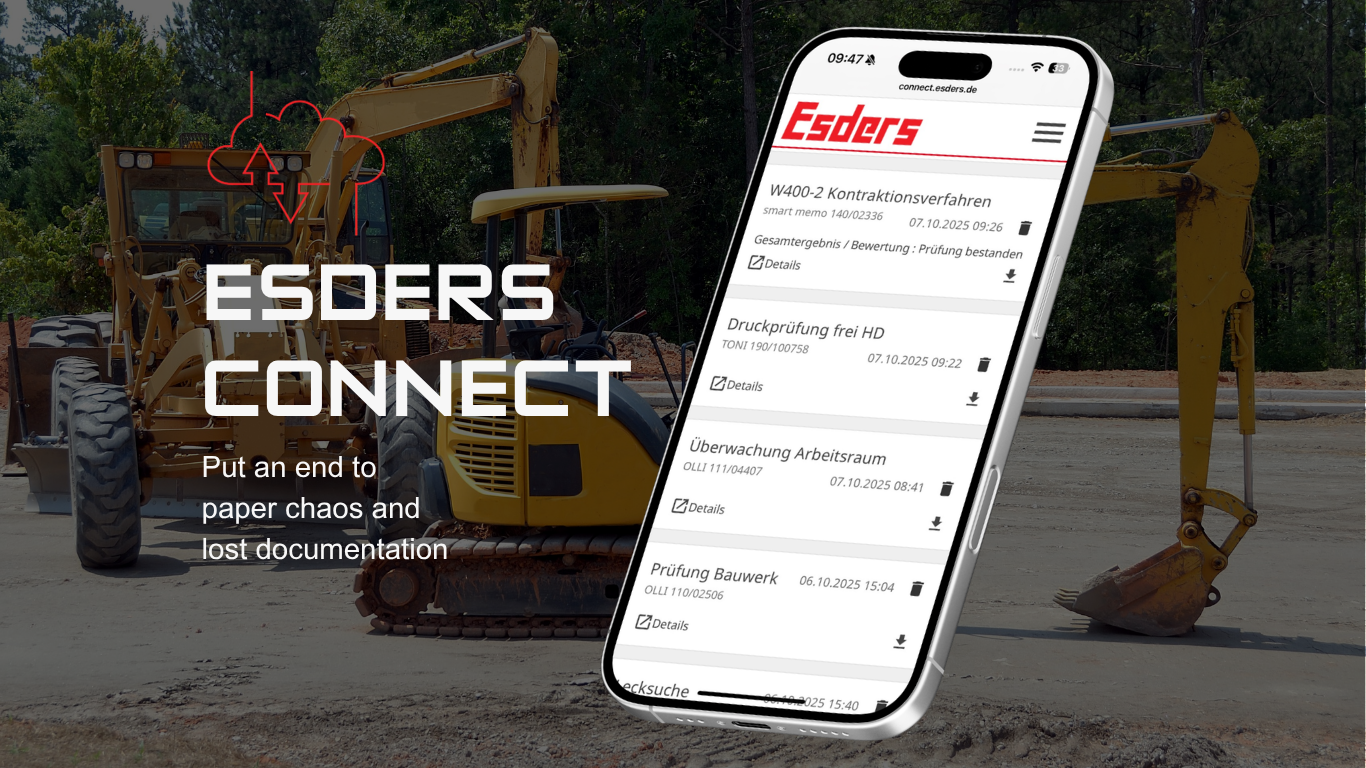
Depending on the device’s specifications, test reports can be sent directly to pre-registered email addresses via the optional LTE module. Without the LTE module, the smart memo can be connected to the Esders Connect app. The app allows you to view measurements, add further details and send test reports.
The measurements transmitted are stored centrally in the browser-based Esders Connect Portal. This means that measurement data does not need to be manually copied from the device and recompiled for later documentation.
Live measurement during extended pressure tests
On suitably equipped devices, the progress of an ongoing test can be monitored remotely via live measurement. To do this, the smart memo transmits current measurement values to Esders Connect at regular intervals.
Reliability of measurement progression
Live measurement is available for most menu items, including water pressure tests in accordance with DVGW W 400-2, EN 805, ÖVGW W 101 and SVGW W4, FW 602, the free pressure test, the EDS2 data logger and G469. This requires an LTE module, MDE data stored in the device and the relevant digitisation option/feature subscription.
This makes it possible – particularly during longer or automatically running tests – to monitor how far the test has progressed and whether the measurement trend continues to appear plausible.
Frequently asked questions about pressure tests, leak tests and the smart memo
Here are brief, concise answers to the most important questions about the smart memo.
What is the smart memo?
The smart memo is an electronic pressure test kit for leak and pressure tests in gas and water supply, wastewater disposal and other areas of pipeline infrastructure. It operates using menu-driven test sequences and can be connected to various external EDS2 sensors.
What tests can be carried out using the smart memo?
Depending on the software option installed, the smart memo supports, amongst other things, sewage tests in accordance with DIN EN 1610, water pressure tests in accordance with DVGW W 400-2 and EN 805, gas pipeline tests in accordance with DVGW G 469, district heating tests in accordance with AGFW FW 602, and speedpipe tests in accordance with ZTV TK Netz 40. Further options are available, for example, for pressure sewer pipes and borehole heat exchangers.
What is the difference between a leak test and a pressure test?
In a pressure test, a test object is subjected to a specified pressure and the pressure curve is measured over a defined period of time. Whether the test also serves as a tightness, strength or load test depends on the relevant regulations and test procedure. The smart memo guides the user through the stored procedure and evaluates the measurement, provided that automatic evaluation is specified for the selected procedure.
Which sensors are required for a test?
The sensors required depend on the test procedure. Among others, EDS2 sensors for pressure, temperature, flow and level are available. Up to five external sensors can be connected to the smart memo at the same time. Before the test, it is therefore necessary to clarify which set of standards is to be applied, what the test pressure is to be, and which parameters need to be measured.
How are the results of a test documented?
The smart memo stores the measured values and generates a digital test report. Depending on the test procedure, this includes, amongst other things, details of the test object, the tester, the pressure and time history, and the test evaluation. The data can be transferred via the Esders Connect app or the optional LTE module and managed in the Esders Connect Portal.
Can the smart memo be upgraded with additional test procedures at a later date?
Yes. Software options, functions and test procedures can also be purchased at a later date and installed on the device via the Esders Connect app. The new application will also require the appropriate sensors and, where necessary, additional test accessories.
Who is the smart memo particularly relevant for?
The smart memo is aimed at companies and professionals who carry out leak or pressure tests on pipes, shafts and other test objects and who need to document the results digitally. These include, for example, network operators, utility companies, pipework contractors and service providers in the wastewater, water, gas, district heating and fibre-optic network sectors.