
Hydrogen in the gas network: Safe measurement, testing and flaring
Measurement technology for the safe handling of H2 in the gas infrastructure
Hydrogen already plays an important role in the energy supply as a result of various energy initiatives and is therefore more than just a potential alternative. However, its use also brings about changes in the requirements for the measurement technology employed and for general work on gas pipelines.
From measurement and pressure testing to controlled flaring: here you can find out what matters when handling hydrogen and which technologies can support you when working on H₂ pipelines.
Challenges in the use of hydrogen
Different properties require appropriate measurement technology
Hydrogen differs fundamentally from natural gas or methane in terms of its key physical properties. The gas has a very low density, an extremely small volume and a wide ignition range. At the same time, pure hydrogen applications strictly require compliance with the stringent Explosion Group IIC. Due to this high volatility, even the smallest leaks can pose a safety risk – details that often played a minor role in previous natural gas operations. For network operators, this means that conventional measuring instruments reach their limits here. Highly sensitive, H₂-specific sensor technology with IIC approval is required to reliably detect leaks and safely monitor installations.
Practical examples and areas of application
How hydrogen-based testing and measurement can be implemented in practice
Using specific applications as examples, we demonstrate how hydrogen can be measured safely, how pipes can be tested, and how gas volumes can be flared in a controlled manner.
Related products
Frequently asked questions about hydrogen applications
Which measurement technology is suitable for hydrogen in gas networks?
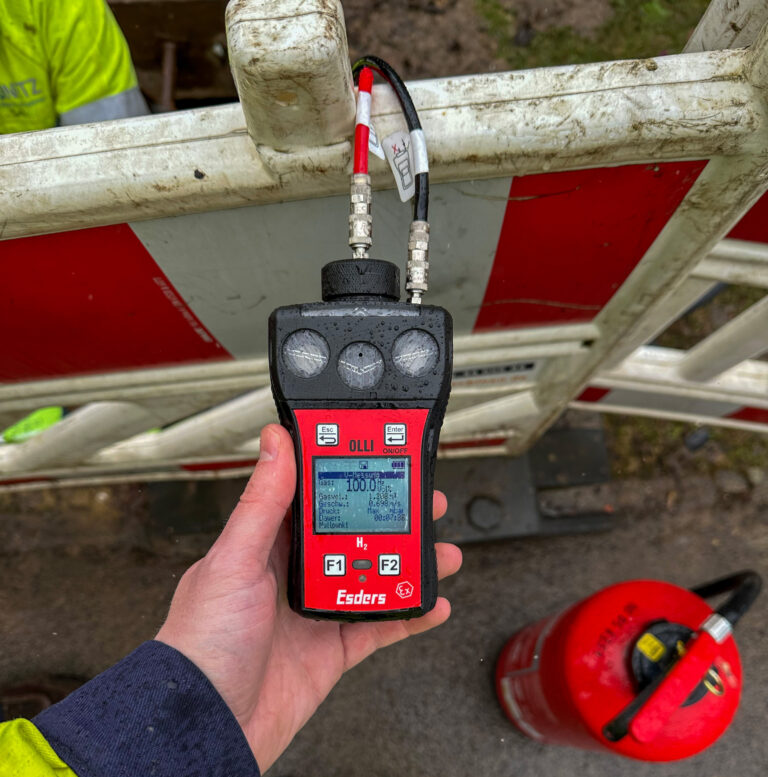
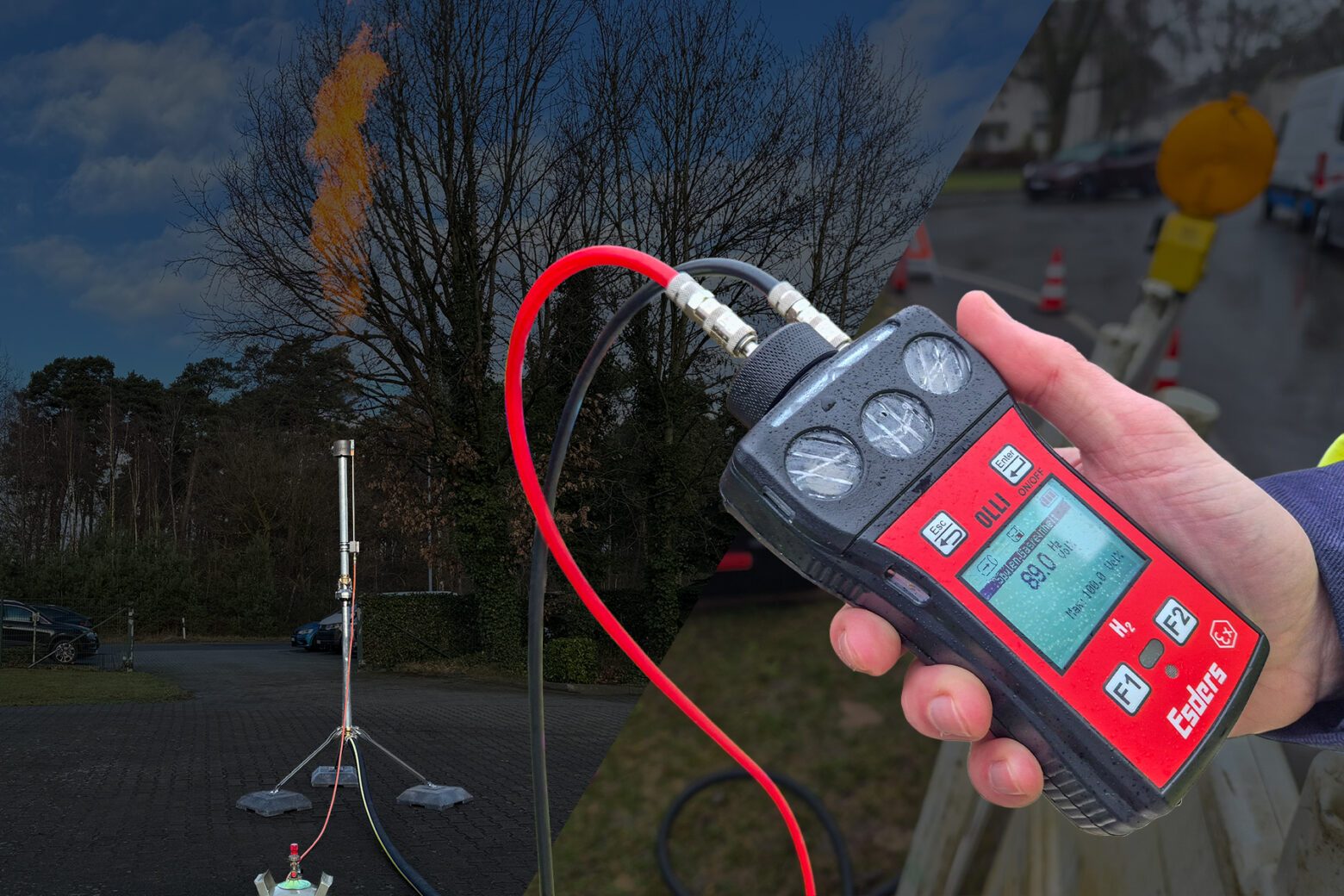
When it comes to hydrogen, the sensor principle used and explosion protection play a crucial role. As hydrogen is classified in explosion group IIC, the equipment used must be certified to meet these stringent requirements. This is precisely where our OLLI H2 comes in: it is specifically designed for hydrogen measurements up to 100% by volume H₂ and is ideally suited for monitoring work areas and hydrogen flaring operations.
Why is hydrogen measurement technology required for explosion group IIC?
Hydrogen has a very low ignition energy and an extremely wide ignition range. For this reason, the gas is classified in the highest explosion group, IIC, which imposes particularly stringent requirements on explosion protection. When working on pure hydrogen pipelines, it is therefore essential to ensure that all measuring devices, flares and accessories used are explicitly approved for IIC applications.
What needs to be taken into account when carrying out pressure tests on hydrogen pipelines?
In some cases, the requirements for pressure tests on H₂ pipelines are stricter than those for the conventional natural gas network. The DVGW Supplement G 469-B1 supplements the existing test procedures specifically for hydrogen. In practical terms, this means that additional specifications must be strictly adhered to, particularly when carrying out pressure measurement procedures.
Can hydrogen simply be vented from a gas pipeline?
No, the uncontrolled release of hydrogen should be avoided for safety and environmental reasons. During operations such as decommissioning, repairs or purging, hydrogen can instead be burned in a controlled manner via a suitable gas flare. A flame arrestor suitable for H₂ and continuous monitoring of the entire flaring process are crucial for safety.
Further reading on the subject of hydrogen
Blog

New requirements for pressure tests on hydrogen pipelines according to DVGW G 469-B1
Table of Contents Until now, the focus of pressure tests for gas pipelines according to DVGW was on natural gas. However, due to the increasing use of hydrogen (H2) as an energy source, the requirements are changing. With the introduction of the supplementary sheet G 469-B1, the DVGW has now

Safety due to a flame arrester
Table of Contents We have been offering flaring devices or gas flares for flaring hazardous gas mixtures for many years. Since then, our mobile gas flares have been successfully used in a wide variety of applications, most of them in the field of gas supply. In the gas distribution network,

Effects of the addition of hydrogen to natural gas on the explosion protection of gas measuring and gas warning devices
Table of Contents In our article of 09 June 2020 on the use of existing measurement technology in gas networks with hydrogen components, we dealt with the properties of hydrogen, the suitability of different sensor technology and the explosion protection of the devices when used in natural gas-hydrogen mixtures. In
Would you like to consult with our experts or see a live demonstration of our hydrogen-related devices?
We’ll answer your questions about detection, testing methods, or our measurement technology. Simply leave your contact information.
We’ll get back to you as soon as possible.
