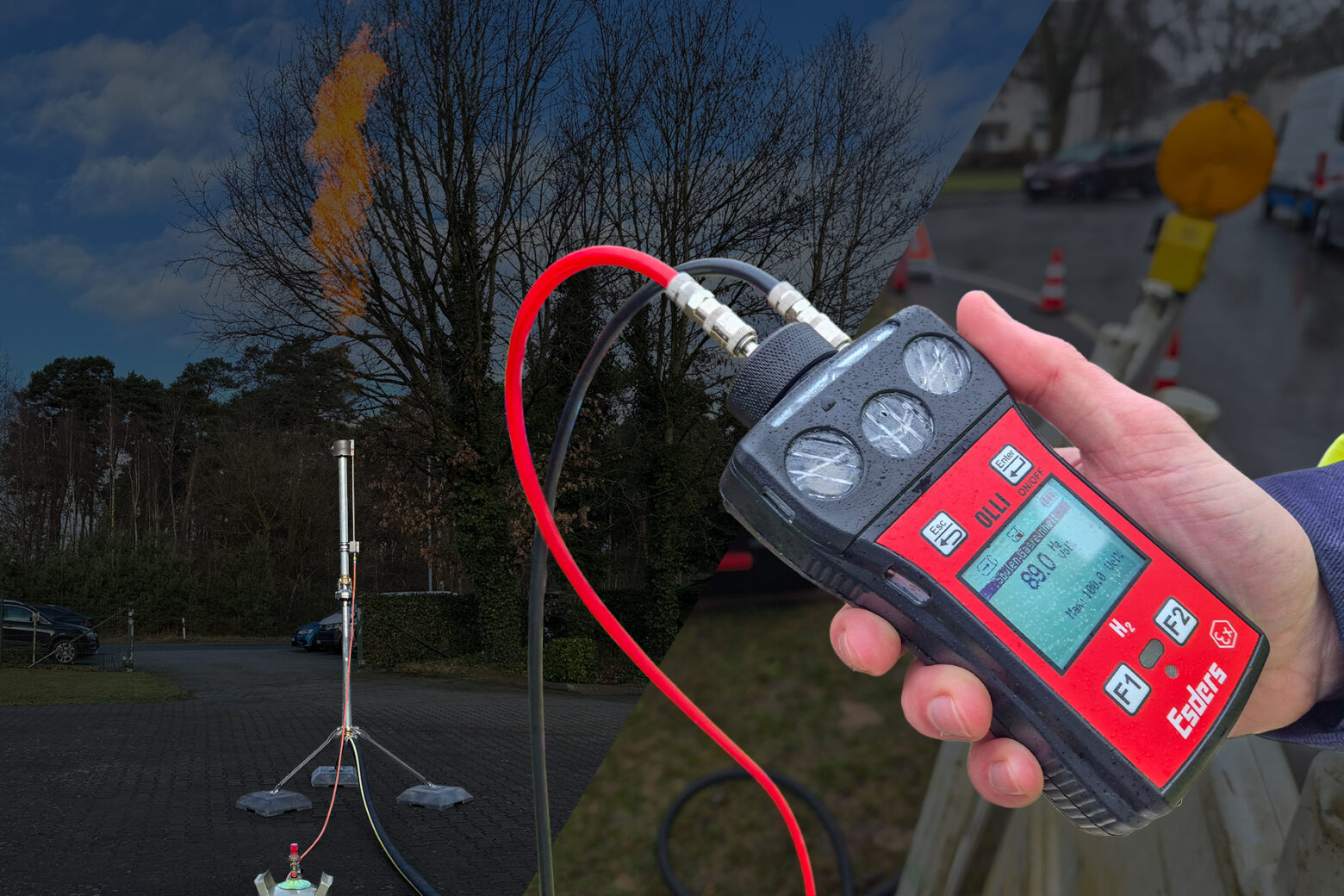
The transformation of the energy and gas networks is in full swing. With the increasing supply of hydrogen (H₂) into the existing gas infrastructure and the construction of dedicated hydrogen pipelines, network operators and service providers are facing new challenges. A key question arises, particularly during the commissioning, decommissioning or purging of pipelines: how do we deal with the hydrogen that needs to be displaced or released from the pipelines?
Controlled flaring of hydrogen instead of venting into the atmosphere
Simply venting (releasing) is not an option. There are two key reasons for this:
- Safety (risk of explosion): Hydrogen has an extremely wide ignition range and belongs to the highest explosion group (IIC). Uncontrolled venting poses safety risks.
- Climate protection (GWP): Although hydrogen is not a direct greenhouse gas like methane (CH₄) or carbon dioxide (CO₂), it does have a significant indirect global warming potential (GWP). In the atmosphere, hydrogen prolongs the lifetime of methane and influences ozone formation. Uncontrolled release into the atmosphere must therefore be minimised.
The solution is the controlled flaring of the gas.
Regulatory framework for hydrogen flaring
DVGW Technical Leaflet G 404 provides the basis for the flaring of gases. Mobile gas flares are described here as an effective tool for reducing gas emissions.
However, the physical properties of hydrogen require specialised equipment. H₂ has a very low density, diffuses extremely rapidly and burns with an almost invisible flame. Most importantly, however, it is classified in explosion group IIC. The equipment used, from measurement right through to combustion, must meet these highest safety requirements in order, for example, to prevent a flashback into the pipeline under all circumstances.
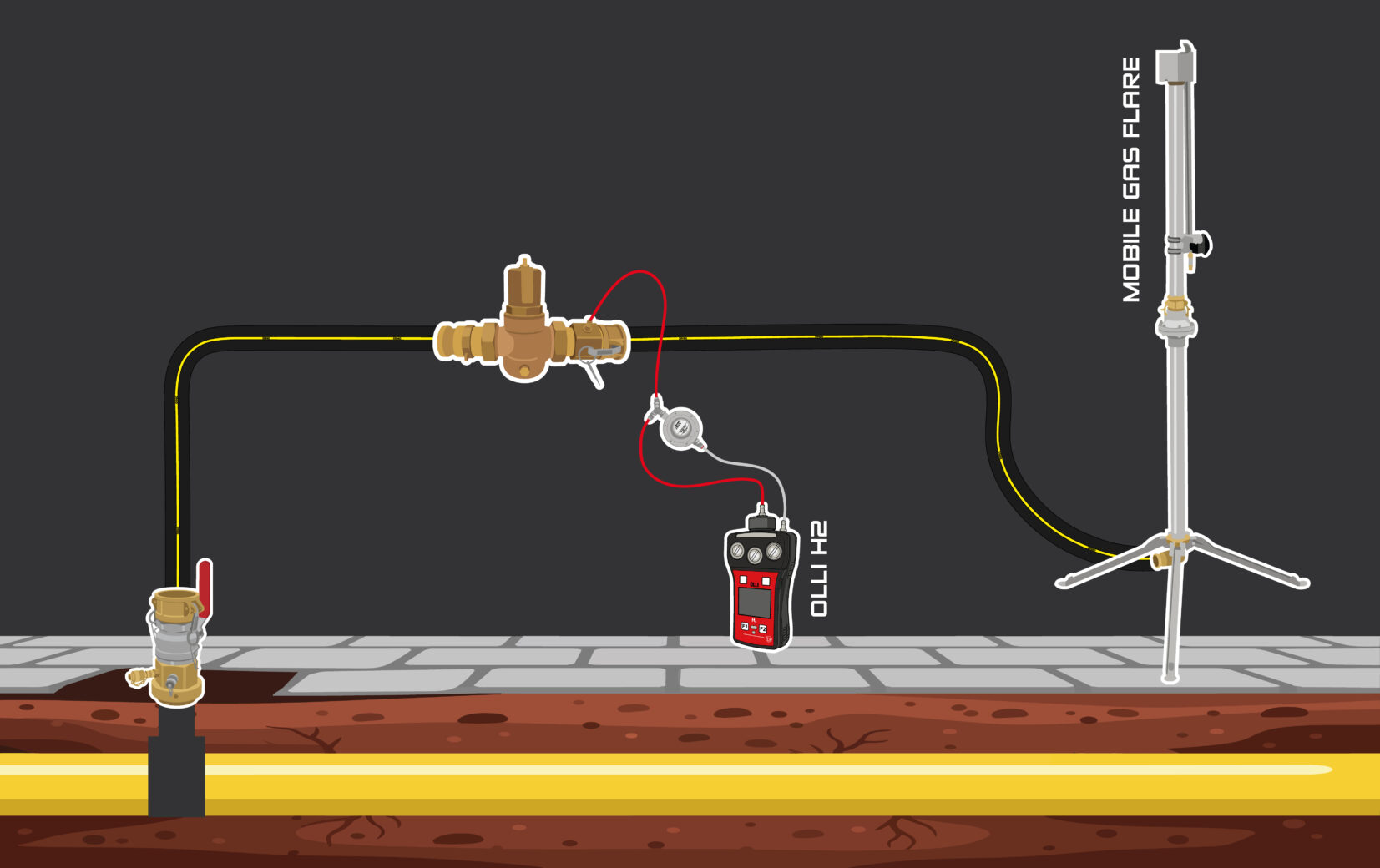
The duo for hydrogen applications: OLLI H2 & Mobile Gas Flares
To ensure that all processes are carried out safely, with low emissions and proper documentation, the OLLI H2 and the Mobile Gas Flares form a perfectly coordinated system.
1. Mobile Gas Flares
Our Mobile Gas Flares are designed for flaring natural gas, propane and hydrogen.
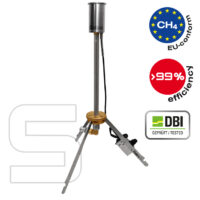
- Mobile Gas Flare S: Designed to meet the requirements for house connections and network connection pipes. It weighs only 2,850 g, is particularly easy to use, is quickly ready for operation and achieves flow rates of up to 8 Nm³/h (based on methane at 1 bar).
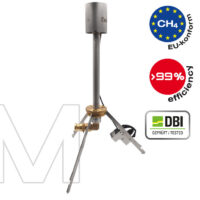
- Mobile Gas Flare M: Ideal for low- and medium-pressure distribution networks. It is compact, quick to set up and, with a throughput of up to 40 Nm³/h (based on methane at 1 bar), extremely efficient.
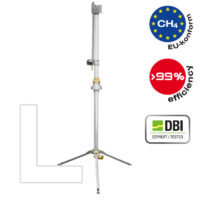
- Mobile Gas Flare L: Designed for the medium- and high-pressure networks. It has a significantly higher capacity (approx. 800 Nm³/h at > 2 bar) and, despite its height of 2.5 metres, can be assembled from two parts in just a few minutes without any tools.
2. OLLI H2 gas measuring device
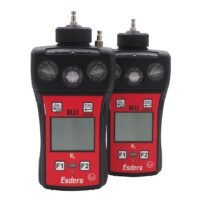
The OLLI H2 is our explosion-proof, compact, multifunctional device for measuring hydrogen (0 to 100 vol.%). It is ATEX-certified for device group IIC. Equipped with a high-performance pump, it is the ideal instrument for monitoring the flaring process. The key additional feature here is the integrated V-measurement (volume measurement).
3. Explosion group IIC
All three gas flare models are fitted with an integrated flame arrestor, which is approved for gases in explosion groups IIA, IIA1, IIB and, in particular, IIC. An integrated continuous ignition system ensures stable combustion in all models, with an efficiency of approximately 99% under ideal conditions.
How to safely flare hydrogen: Step-by-step guide
In practice, gas flaring usually begins when there is an urgent need for repairs. A fault has occurred in the pipeline due to ageing and wear, corrosion or a leak. The ground is excavated, the damaged section of pipe is exposed, and the affected section is disconnected from the rest of the network. Then the actual decommissioning process begins:
Step 1: Ensure the work area is safe and connect the flare
Ensure that the work area is safe. Use the ‘Confined space entry’ menu item on the OLLI H2 to check the ambient air for hydrogen leaks. Once you have checked the area, select a suitable model of the Mobile Gas Flare – depending on the prevailing line pressure and gas volume – and connect it to the pressure relief point on the pipeline.
Step 2: Configure the OLLI H2 and start the V-Measurement
In the OLLI H2’s main menu, select the ‘V-Measurement’ menu item. Then, select ‘Hydrogen’ as the gas type and choose the flare you are using. Next, enter the internal pipe diameter. This value forms the basis for the subsequent calculation of the flow velocity.
Step 3: Set up the measurement system on the pressure regulator
Now that the sensor initialisation phase is complete, connect the OLLI H2 to the pressure regulator of the venting device using the special connecting hose for V-Measurement. The tabs on the connecting hose help to ensure correct installation. The connecting hose has a pressure and gas path for the measurement device, enabling the OLLI to measure the gas concentration and the flow rate.
Step 4: Ignition and controlled flaring
Activate the continuous ignition of the Mobile Gas Flare and open the valve. Hydrogen is fed into the flare in a controlled manner, where it is safely combusted. The integrated IIC flashback arrestor ensures at all times that the flame cannot flashback into the pipeline. Throughout the entire flaring process, you can monitor all key parameters via the OLLI H2 display. The device continuously records and logs:
- The current gas concentration
- The total volume of gas flared
- The flow rate in the pipe
- The pressure downstream of the pressure regulator
- The duration of flaring to date
Step 5: Completion and digital documentation
The depressurisation process is safely finished once the gas concentration, pressure and flow rate readings have dropped to ‘0’. The measurement on the OLLI H2 is now stopped. Finally, the complete record of the process can be sent quickly and easily to the Esders Cloud via the Esders Connect app. This ensures that comprehensive, legally compliant documentation of emission prevention is completed directly from the construction site.
Digital and legally compliant documentation
Alongside safety, the requirement for documentation is becoming an increasingly important focus. This is where the OLLI H2 demonstrates its digital strengths: all measured volumes and test data are managed digitally via Esders Connect.
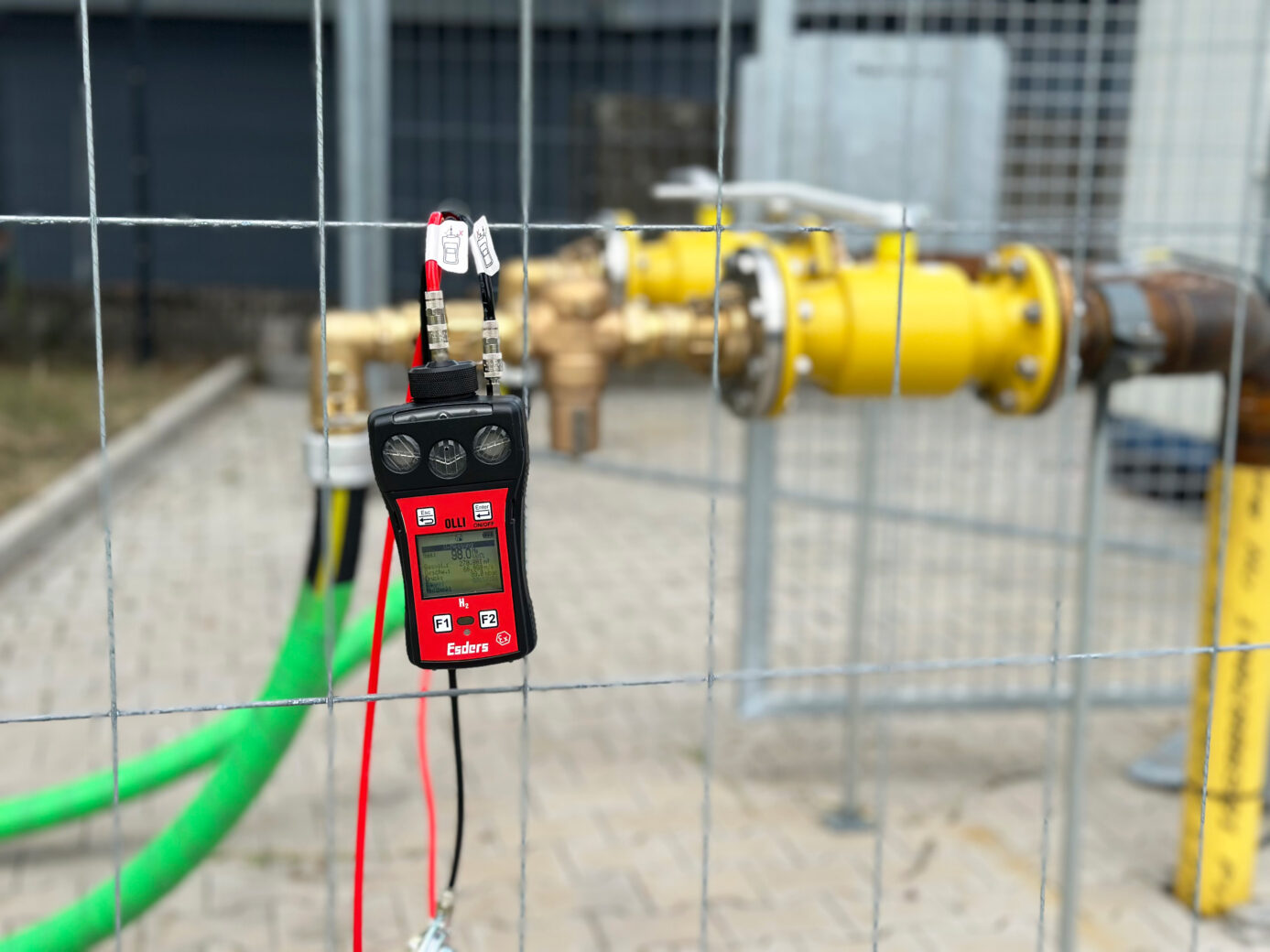
The measurement results are transmitted directly from the construction site to the office via an app. Test reports (including the amount of hydrogen flared) are generated automatically and stored in the cloud. This not only saves time on site, but also provides reliable data for reporting immediately. In Esders Connect, all details of the process, including location and MDE data, can be viewed directly at any time and saved locally.
Feel free to contact us for more information!
Would you like to work with hydrogen as part of a forward-looking approach, or are you interested in other technologies?
We’d be happy to help!