
Impact of the EU Methane Regulation on work on gas pipelines
With the entry into force of the EU Methane Regulation, greater focus is being placed on the systematic reduction of methane emissions in the gas network. Methane is considered a particularly harmful greenhouse gas, which is why emissions across the entire gas infrastructure – from production to distribution – must be more strictly monitored and reduced in future.
Work on gas pipelines has been part of network operators’ daily routine for decades. In terms of occupational safety, there are established processes, regulations and procedures for the repair and maintenance of pipelines. However, the EU Methane Regulation now introduces additional requirements, particularly with regard to quantification, emission monitoring, and emission prevention and reduction during maintenance work.
These new requirements have a direct impact on existing processes within the gas network – particularly in relation to leak detection, classification, repair and decommissioning of pipeline sections.
Practical application: Work on gas pipelines in accordance with the Methane Regulation
Leak detection and assessment as part of LDAR measures
Pipeline network operators must carry out regular pipeline inspections to comply with the LDAR requirements set out in DVGW G 465-5 and G 424. The procedures specified in DVGW G 465-1 and DVGW G 466-1 are used for this purpose, e.g. gas pipeline inspections using e-scooters or GasCar, or another method. These methods are becoming increasingly important in the context of the Methane Regulation, as they enable the efficient and comprehensive recording of emissions.
Leak detection validation
If a leak is detected during this inspection and a gas escape is measured, further action is taken in accordance with DVGW G 465-3 and DVGW G 424.
- Localisation of the leak, e.g. via ground air measurements using the Laser HUNTER
- Classification of the leak
- Determination of appropriate measures
- Comprehensive documentation
Depending on the classification, either a refurbishment or replacement of the pipe section, or a targeted individual repair, is then scheduled. Class A1 leaks must be rectified immediately, whilst Class C leaks must be repaired within six months (see DVGW G 465-3).
From 2024, the requirements of DVGW G 424, Section 5.4 “Repair” will also apply: if a leak exceeds the limit values defined therein (e.g. 7000 ppm methane) and a repair cannot be carried out within five days, additional measures to reduce methane emissions must be implemented. Furthermore, emissions must be reported and delays in repairs must be justified in a transparent manner.
Carrying out a one-off repair of a leak
When carrying out a one-off repair, the requirements set out in DIN EN 12327, DVGW G 465-2 and DGUV Information 203-090 must be observed. Work on gas pipes that are in service requires a high level of technical and organisational safety.
The first step is the temporary isolation of the pipe section, e.g. using inflatable plug installation devices. The aim of the repair work is to work in a gas-free environment wherever possible. To achieve this, it is necessary to monitor the level of residual gas and ensure it is safely vented.
At the same time, DVGW G 424 requires methane emissions to be minimised as far as possible. The following options should therefore be considered before the work begins:
- Reduction of operating pressure
- Diversion of gas to other pipeline sections
- Use of mobile compressors
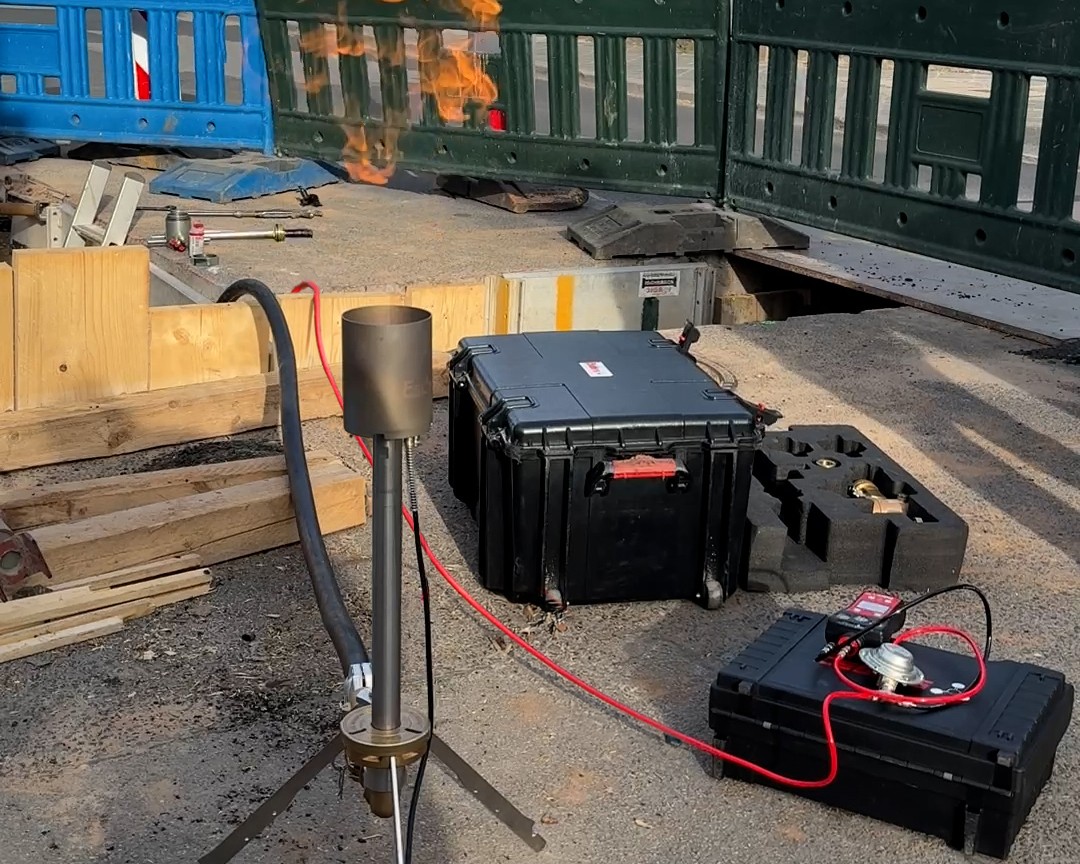
Once the pipeline section has been shut off, the section can be taken out of service using a Mobile Gas Flare. In this process, the residual gas is safely vented and burned, converting methane into CO₂, which is significantly less harmful to the climate. Only then is the actual repair of the leak carried out.
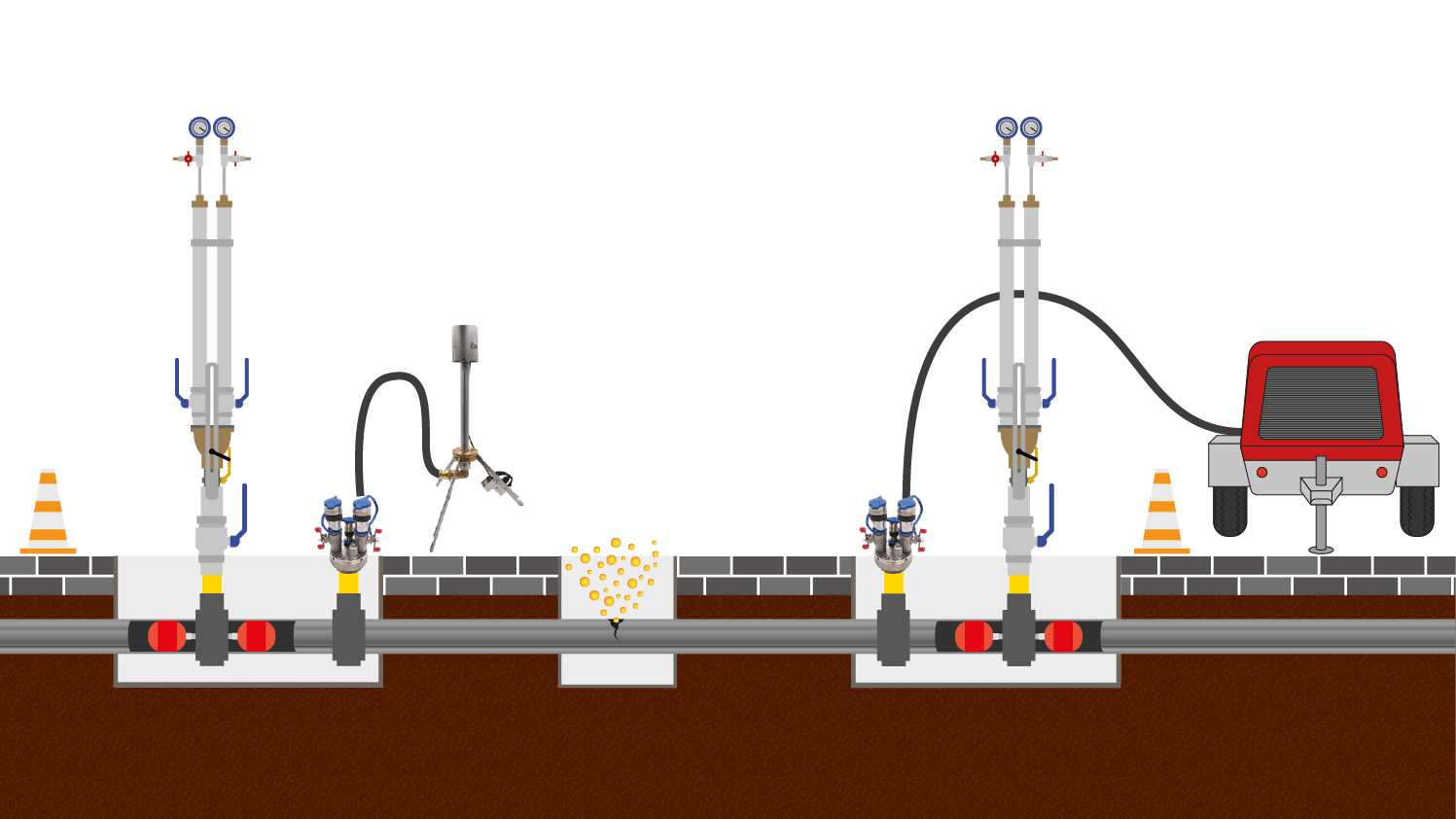
Deployment of the Mobile Gas Flare M at a roadblock
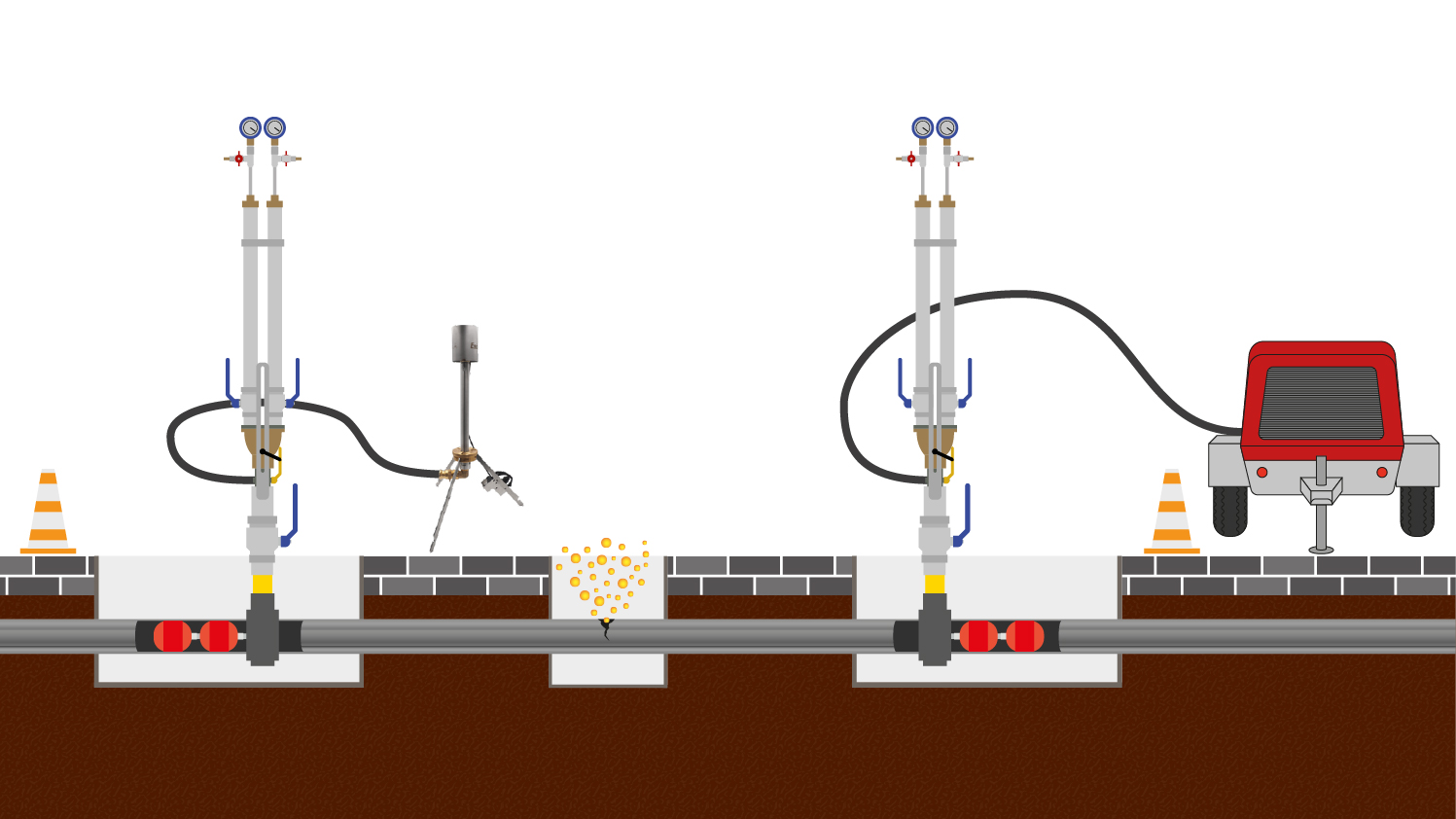
In practice, the isolation section is often created using devices for installing inflatable pipe plugs in accordance with section 6.2.2.3 of DGUV Information 203-090. When using a device for installing double pipe plugs, the isolation balloons must be positioned on the side facing away from the leak. This allows the isolation section to be taken out of service directly via the connection on the inflatable plug installation device (see Fig. 1). A Mobile Gas Flare M can be connected there using a suitable adapter and the appropriate accessories.
To depressurise the isolated section (simple pressure relief), connecting the gas flare, including the necessary accessories, would be sufficient. The operating pressure in the pipeline can be relieved by controlled flaring of the gas via the gas flare. However, to achieve a gas-free state, it is not only necessary to depressurise the section, but also to carry out a subsequent purging process.
To do this, the gas pipeline is purged or flushed with an inert gas or air in accordance with DVGW G 465-2. This requires an additional access point at the opposite end of the isolated section, through which the residual gas – for example, using a compressor – is conveyed towards the gas flare and safely burned there.
The gas-free condition can be verified by measuring the gas concentration using a suitable measuring device (see DVGW G 465-4), e.g. the OLLI. The pipeline is considered gas-free when the natural gas concentration remains safely below 50% of the LEL for the duration of the work (DVGW G 465-2). At the same time, the volume measurement in the OLLI allows the quantity of gas flared to be metrologically determined and documented, enabling pipeline operators to fulfil their reporting obligations under the EU Methane Regulation (see also this blog post on the OLLI).
Efficient methane reduction using Mobile Gas Flares
Mobile Gas Flares are an effective and safe tool for creating a gas-free environment when working on gas pipelines that are in operation. At the same time, they make an important contribution to reducing methane emissions in the context of gas network maintenance.
In accordance with the EU Methane Regulation and the requirements of DVGW G 424, Esders GmbH’s gas flares achieve the required destruction and separation efficiency of at least 99%. They thus help network operators to reliably meet both safety and climate policy requirements.