DVGW Worksheet G465-1 describes both scheduled and unscheduled, situation-dependent inspections of gas pipeline networks with an operating pressure of up to 16 bar. This worksheet is and remains the basis for the safety inspection of the entire gas network, from distribution up to and including the network connection.
The currently valid version G465-1 05/2019 specifies inspection intervals for areas within and outside built-up areas, network connections and also exposed pipes, which are essentially determined on a condition-based basis by the number of gas leaks, the operating pressure and the pipe material.
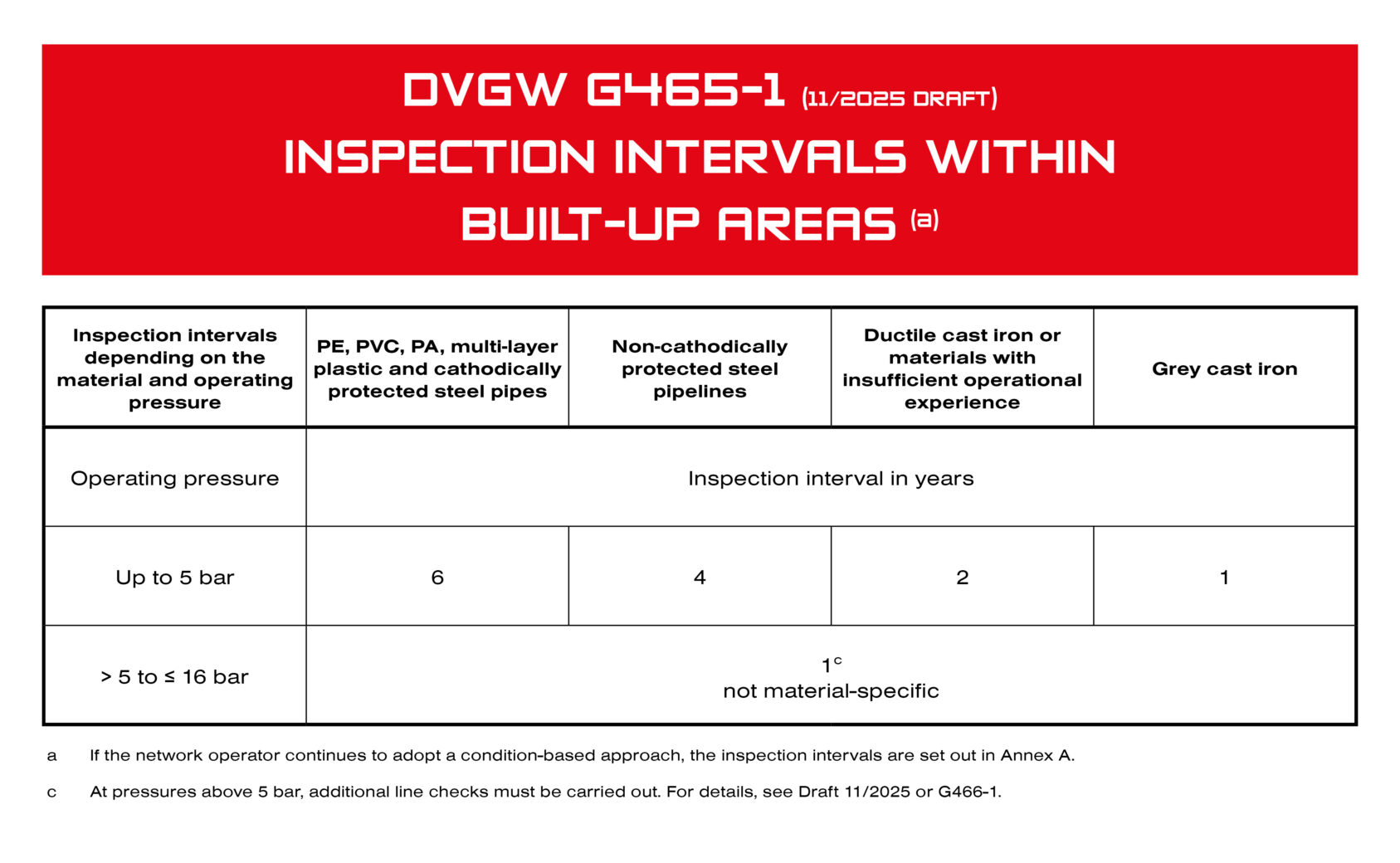
The revised version of G465-1 (draft 11/2025) is being adapted, amongst other things, to ensure compatibility with the overarching EU Methane Regulation 2024/1787 regarding inspection intervals. It takes into account that the frequency of gas leaks depends on the material. This relationship and the necessary standardisation form the basis for the new material-oriented inspection intervals in the draft G465-1, see Table 1.
Table 1: Inspection intervals taking into account the material, operating pressure and the corrosion protection applied in accordance with draft G465-1 within the development:
(For clarity, the tables for the inspection periods of areas outside built-up areas, as well as for exposed gas pipes and bridge pipes, are not shown here. Please refer separately to the applicable worksheet G465-1 for these. The inspection of gas network connections will in future be described in G459-1; see draft 09/2025.)
G465-5: Determination of methane emissions
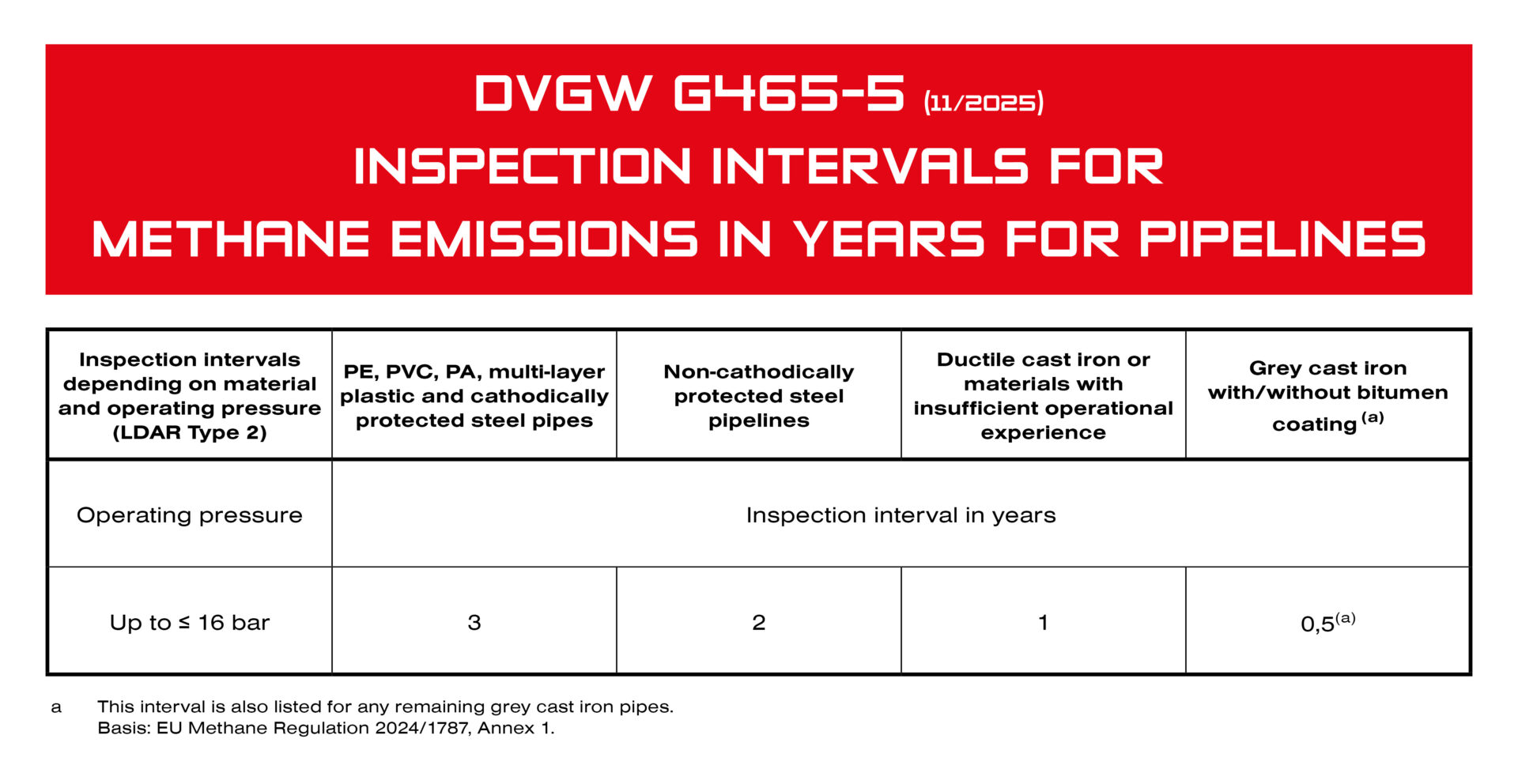
DVGW Technical Note G465-5 describes the procedures for complying with the requirements of the EU Methane Regulation. The aim is to reduce methane emissions through regular, recurring inspections of the gas network in public areas. The results of the inspections must be assessed and reported by the network operator; G465-5 provides the necessary framework for complying with the requirements of the EU Methane Regulation.
In line with G465-1, the inspection intervals are based on the material and operating pressure:
Although this concerns the detection of emissions, safety must never be neglected. This means that, following a two-step procedure, whenever a gas leak is detected (either close to the pipe or from a distance), the site of the damage must be located and classified in accordance with G465-3 without undue delay.
In the event of gas leaks classified as AI, safety measures must be taken immediately and the leak must be stopped and repaired straight away.
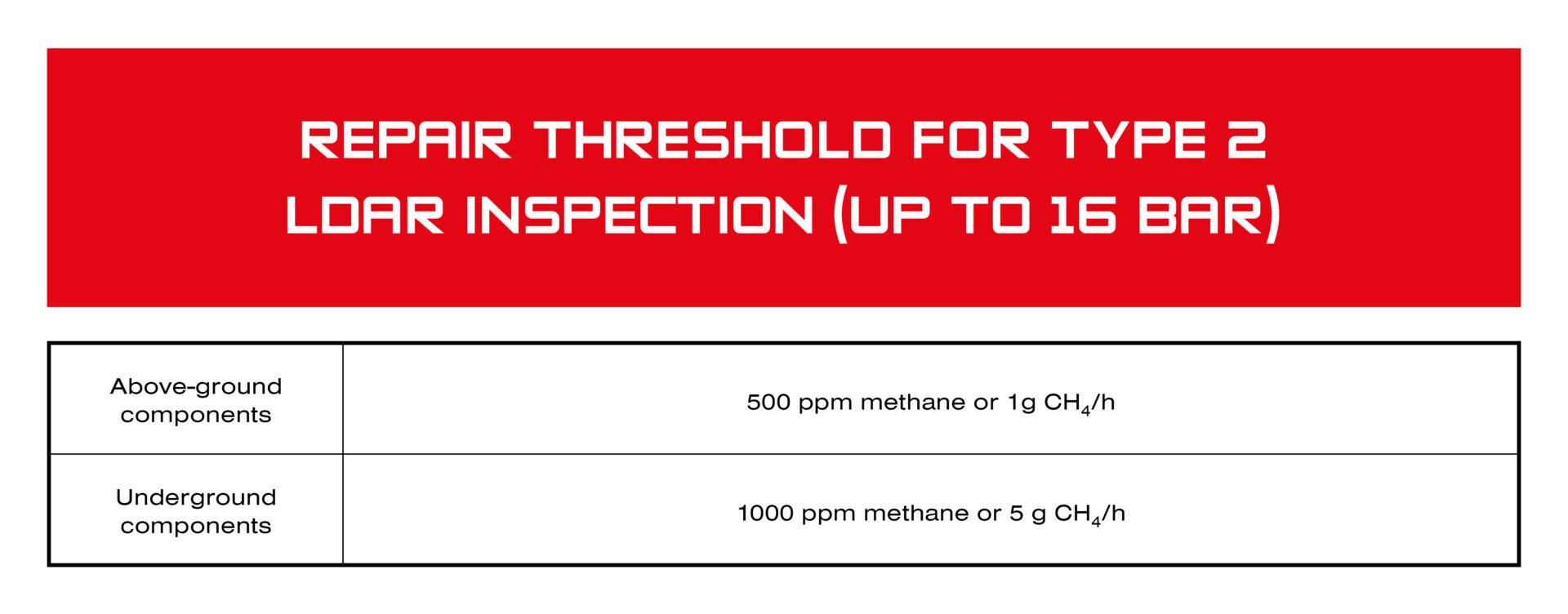
In the event of gas leaks classified as AII, B or C where the repair limit has been exceeded, the repair must be carried out within 5 days due to greenhouse gas emissions. It should be noted that, for safety reasons, AII damage must be repaired within this timeframe and monitored daily for any further gas spread.
If the repair threshold is exceeded, high greenhouse gas emissions must be minimised as quickly as possible and stopped within 5 days. For AI (immediately) and AII (5 days), these repair times are already mandated for safety reasons by G465-3. For B or C damage, delayed repairs must be justified and, where necessary, approved by the authorities. The safety-related timeframes specified in G465-3 continue to apply.
Accurate emissions measurement thanks to quantification
The EU Methane Regulation requires emissions to be quantified and sets out deadlines and reporting requirements. The requirements for the quality of emissions data increase from reporting level 3 to level 5. The aim is to measure emissions directly through quantification. If direct measurement is not possible, specific emission factors are used. Factors for ‘not possible’ are specified in detail in G465-5.
The metrological quantification of methane quantities in g/h is described in the technical notes G425-1ff. For underground pipelines, the extraction method (G425-2) is preferred; for above-ground pipelines, the bagging of flanges, joints and components (G465-3) is recommended.