

Menu

Confined space gas testing: reliable gas detection for personal safety

Before entering a confined space, check carefully to ensure there is no lack of oxygen and that there are no toxic or flammable gases present.

Confined space atmospheric testing protects people from invisible hazards. Before carrying out work in manholes, sewers, tanks or other confined spaces, it is essential to check whether a lack of oxygen or the presence of toxic or flammable gases poses a safety risk. This pre-entry gas testing helps determine whether the atmosphere is safe before personnel enter the confined space. Find out how standard-compliant atmospheric testing is carried out, what requirements apply and which measurement technology supports safe day-to-day working.

Why atmospheric testing is so important before an inspection

The greatest challenge in gas detection is that hazardous gases are neither visible nor always detectable. Depending on the location, oxygen levels and gas concentrations can change within a short space of time. At the same time, manholes, ducts, tanks and silos differ in terms of their design and the hazardous substances they may contain. To reliably identify hazards and ensure personal safety, suitable measurement methods, expert personnel and reliable gas monitoring in confined spaces are crucial.

Atmospheric testing in confined spaces in practice

Our case studies provide practical insights into typical challenges, best practices relating to pre-entry gas testing and the detection of toxic gases in the atmosphere prior to entering manholes, confined spaces and vessels.

Use of the OLLI for atmospheric testing

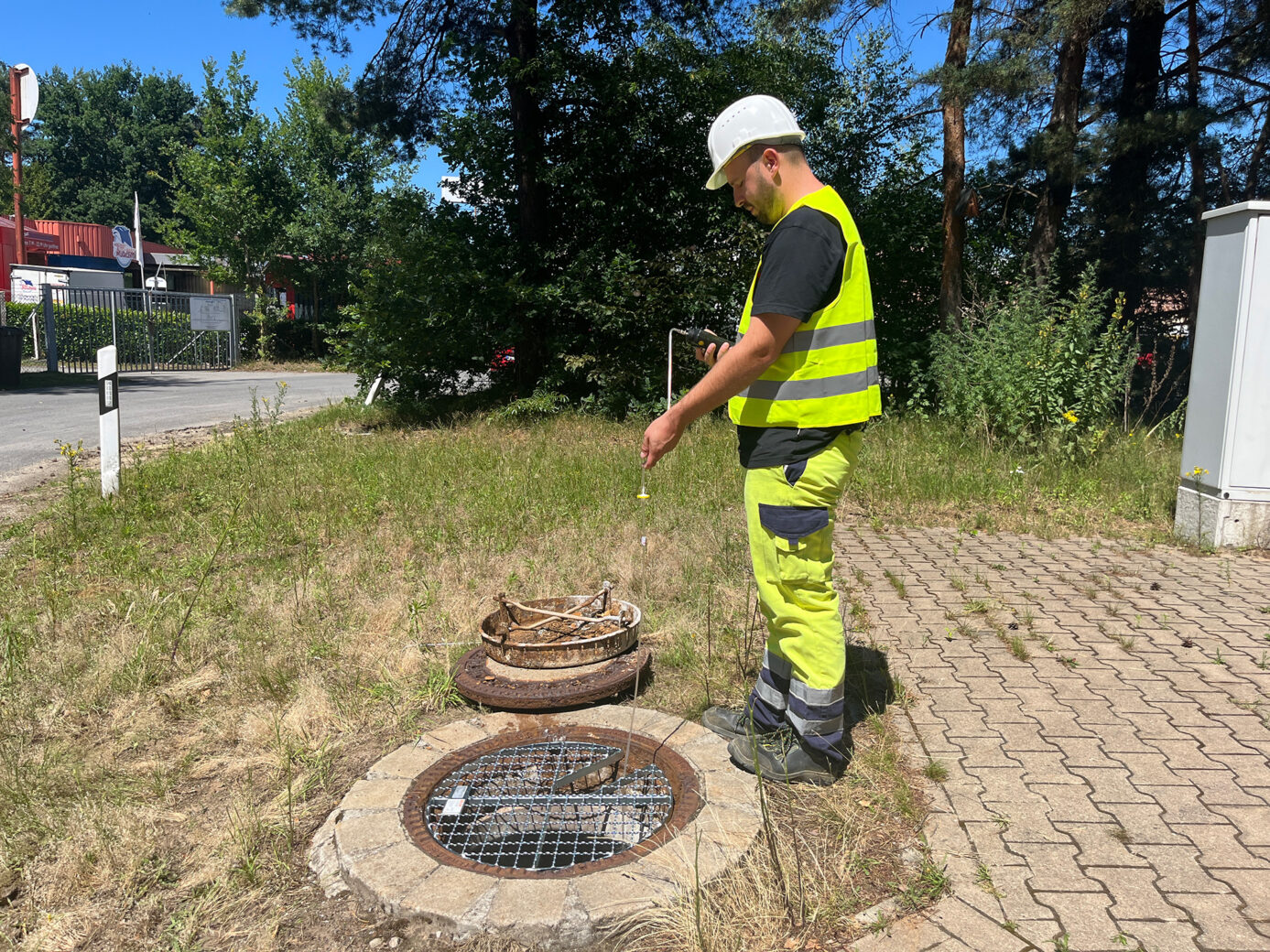
Worker using OLLI for confined space gas testing in a manhole

Pre-entry gas testing in manholes and confined spaces

As part of the maintenance and repair of the water, sewerage and district heating networks, as well as separator systems, inspecting manholes is one of the tasks carried out by specialists. As work on and inside manholes involves various hazards, there are a number of aspects to bear in mind.
Depending on the location of a manhole, the local traffic situation must first be taken into account and, where necessary, measures must be taken to divert traffic. The most common hazards when working in a manhole are those posed by substances – including solids, liquids, vapours and gases in quantities and concentrations that are hazardous to health – as well as the risk of falling. This also applies to tanks, silos and containers.
To protect against falls, a tripod with a fall arrest system, including a rescue hoist function, is usually set up above the manhole. The person working in the manhole is secured to this using safety harnesses and ropes.
In this article, we focus specifically on the hazards posed by dangerous gas concentrations and a lack of oxygen, and describe how to carry out atmospheric testing using the OLLI as a confined space gas detector.

Challenges in atmospheric testing

Confined space atmospheric testing involves determining the potential concentration of hazardous substances or the oxygen content before and during work in confined spaces, with the aim of establishing whether the atmosphere within the confined space permits work to be carried out safely.

It is therefore a measure to protect skilled workers from hazardous substances, which are frequently referred to by the abbreviations Ex, Ox and Tox.

  • Ex stands for the risk posed by flammable and explosive gases.
  • Ox describes the risks associated with a lack of oxygen.
  • Tox stands for the risks posed by toxic gases.

In the vicinity of manholes, typical hazards include methane (CH₄), carbon dioxide (CO₂) and hydrogen sulphide (H₂S), as well as oxygen deficiency (O₂). Depending on the application, H₂S detection, CO detection and the detection of methane and other combustible gases may therefore be required. For combustible gases, the concentration must also be assessed in relation to the lower explosive limit (LEL). Carbon monoxide (CO) may also be relevant, for example where combustion processes or vehicle emissions can influence the atmosphere.

Each country has its own requirements for working in confined spaces. In Germany, for example, it is necessary to comply with DGUV Rule 103-003 ‘Work in Enclosed Spaces of Wastewater Treatment Plants‘ and DGUV Rule 113-004 ‘Tanks, Silos and Confined Spaces‘.
Before work commences, the contractor must set out measures in operational instructions to ensure safe working practices. For specific individual cases, written authorisation must be issued.

Minimise risks with professional confined space gas testing

Hazardous gases are neither visible nor always detectable. Even low concentrations or a lack of oxygen can pose a risk to health or lead to life-threatening situations.
Professional atmospheric testing helps to identify these hazards at an early stage and to implement appropriate protective measures. At the same time, it creates the conditions necessary for working safely in manholes, tanks, silos and containers.
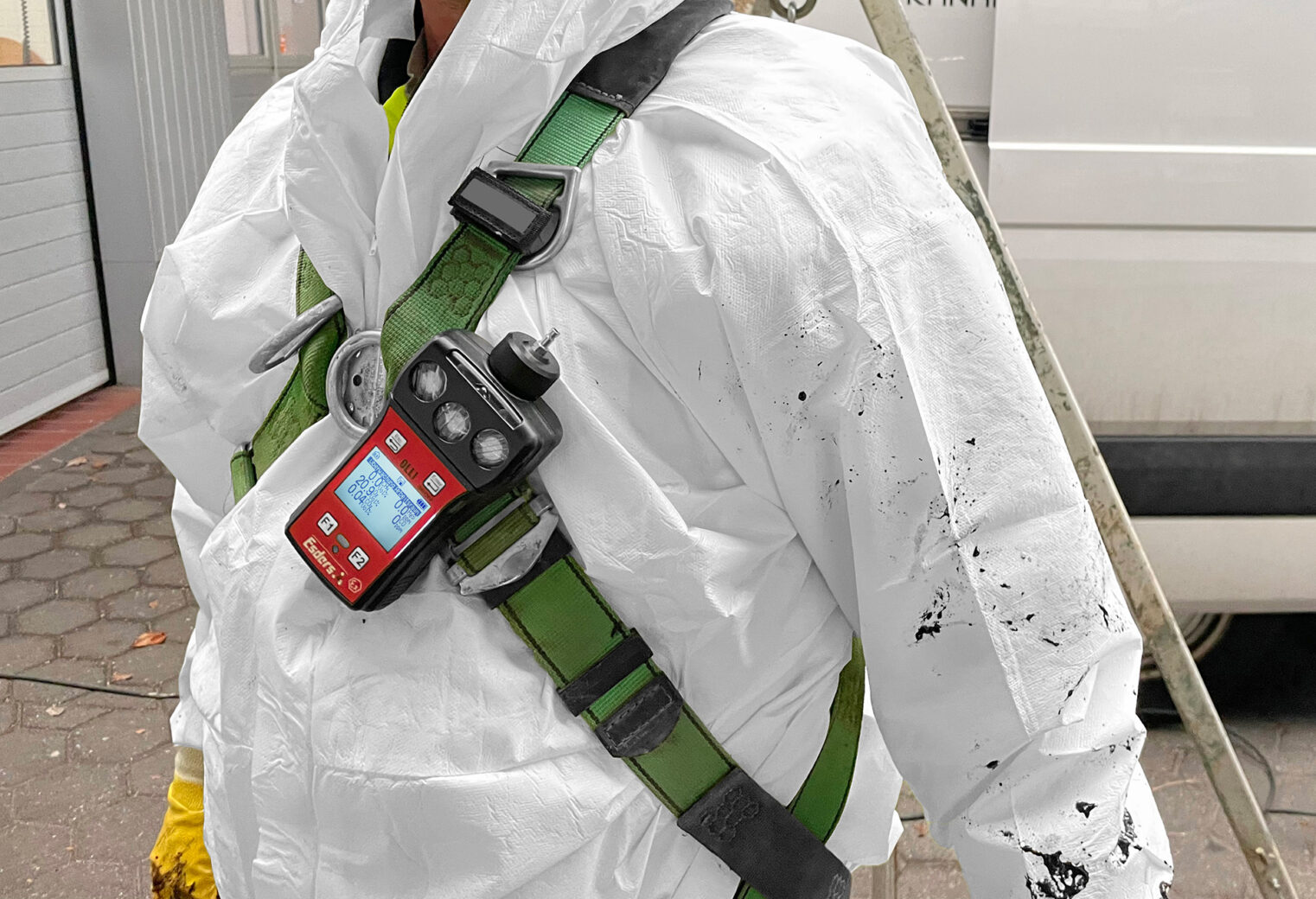
As the atmosphere can change whilst work is in progress, continuous monitoring of the atmosphere is required following atmospheric testing. To do this, the person working in the manhole can attach the measurement device directly to their body. Alternatively, the designated safety officer outside the manhole can deploy the measurement device using a connected floating probe. This also protects the device from contamination.

Atmospheric testing should only be carried out by appropriately trained and competent personnel. The applicable qualification and training requirements depend on national occupational health and safety regulations. In Germany, for example, a person who carries out atmospheric tests in sewer manholes must undergo special training in accordance with DGUV Principle 313-002.

This training ensures that the person has the necessary expertise in:

  • the measuring instruments or methods used,
  • the hazardous substances to be measured,
  • the operational conditions, e.g. the nature of the enclosed spaces, any fixtures and fittings, and any discharges that may influence the measurement.

Atmospheric testing of shafts, silos, tanks and containers requires a high degree of caution and knowledge of safety measures. By adhering to the necessary steps and safety precautions, potential hazards can be identified at an early stage and the safety of employees can be ensured.

Step-by-step guide to atmospheric testing

Step 1: Check the gas detector and perform a bump test

Atmospheric testing is usually carried out using a suitable gas detector with a certified measurement function for explosion protection, oxygen and toxic gases. The OLLI holds these certifications, which were carried out in accordance with DIN EN 60079-29-1, DIN EN 45544 and DIN EN 50104.

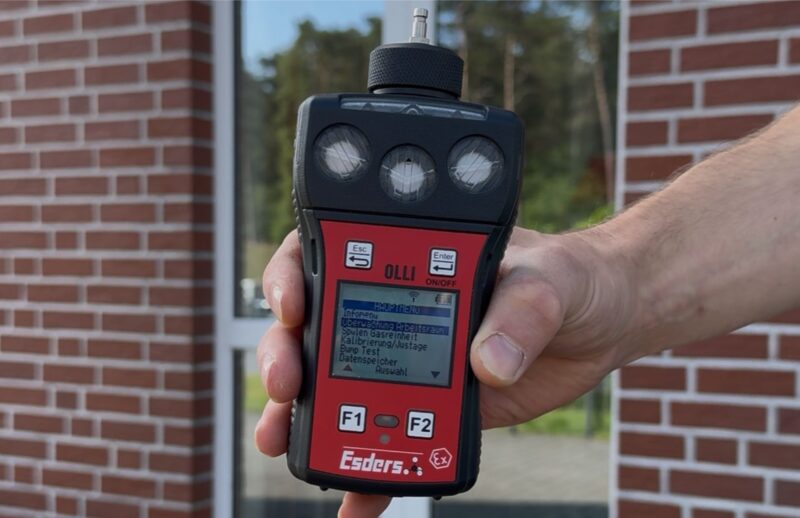
Before atmospheric testing can be carried out, the gas detector must be checked for proper functioning by means of a visual inspection and a quick gas test. During this process, the device, including the probe, is visually inspected for damage and briefly exposed to a suitable test gas to check that it is functioning correctly. The integrated pump is tested at the same time. With the OLLI, this can be done via the menu item Bump Test‘  directly from the main menu.

In addition to the daily quick gas test, a functional check of the device must be carried out at least every four months. This includes not only a visual inspection but also the calibration and, where necessary, the adjustment of the sensors. This procedure can also be carried out directly on the device via the menu item Calibration/Adjustment‘.

All functional checks and quick gas tests must be documented. This ensures a traceable maintenance history for the gas detectors in use. Esders Connect provides a digital, paperless and GDPR-compliant documentation solution for this purpose.

Once the quick gas test and visual inspection have been successfully carried out, atmospheric testing is performed before work begins, i.e. before entering a manhole.

To do this, select the menu item Confined space entry‘ in the OLLI. Switch on the device in clean ambient air. Once the sensor initialisation has completed, the OLLI is ready for use. The measurement is then carried out with the float probe connected.

During the measurement process, the measured values can be read on the display. If these exceed the set limit values, the device triggers an alarm. In this case, the manhole must not be entered. Appropriate measures, such as ventilation or the use of personal protective equipment, must be taken.

Download a template for a work permit

The results of atmospheric tests must also be documented.
What key factors need to be taken into account when carrying out the tests? What data needs to be checked? Our template for an atmospheric test report for work in confined spaces, manholes and containers can make this task much easier for you.

Protocol for atmospheric tests

We have created a special protocol for atmospheric testing, which contains useful information on the threshold values of gas detectors for various gases, as well as a handy table to fill in whilst carrying out measurements. Download it now by filling in the form.

Seminars to gain more practical knowledge

Would you like to further deepen your knowledge of specialist skills for atmospheric testing in manholes, tanks, silos and confined spaces?
Take part in our seminars.

Use of the OLLI as a gas detection and leak detection device in natural gas networks with H2 admixture

OLLI Erstsicherung in Erdgasnetzen mit H2-Beimischung

In addition to the personnel and organisational requirements for fault-clearing management/services, the technical requirements for this purpose must also be met. These include, in particular, the equipment required, alongside vehicles fitted with suitable communication equipment, tools and barrier materials. In this context, we define ‘equipment‘ as the gas detection technology that users require in order to be suitably equipped for the task at hand.
We would like to illustrate what this means in concrete terms – particularly against the backdrop of the increasingly widespread blending of hydrogen with natural gas – using the example of our OLLI gas detection and measuring device.

What needs to be taken into account when it comes to gas alerts and gas detection?

Upon arrival at the site of the fault, the first step is to carry out so-called atmospheric testing, i.e. to use a suitable gas measurement device to check whether an explosive atmosphere is present. For this purpose, a measurement device with a certified measurement function for explosion protection in accordance with DIN EN 60079-29-1 should preferably be used. The OLLI is certified to this standard, amongst others. A full list of certifications can be found on the product page here.

The addition of hydrogen to natural gas presents a further challenge. By utilising the thermal detonation (catalytic combustion) measuring principle in the sensor array, both potentially explosive natural gas-air mixtures and hydrogen-natural gas-air mixtures can be reliably measured in the ‘Confined space entry’ menu option right up to the lower explosive limit (LEL).
The sensor array behaves almost identically in both cases. No separate calibration of the gas detector is required. As the manufacturer of the OLLI, we can, based on internal tests, recommend the safe use of the measuring device up to a hydrogen blend of 30% by volume.
Measuring devices that use an infrared sensor to monitor the environment for potentially explosive atmospheres have significant disadvantages in this regard, as an infrared sensor cannot detect hydrogen.

Adding H2 to natural gas

There are, however, a few points to bear in mind when using the OLLI in the configuration described:

  • Adding hydrogen to natural gas reduces the LEL slightly, as hydrogen has an LEL of 4 vol.%, whilst methane – the main component of natural gas – has an LEL of 4.4 vol.%. To ensure that the gas detector provides a timely warning of a potentially explosive atmosphere, it is therefore recommended that the alarm thresholds be lowered by approximately 5% LEL, or 10% LEL where necessary.
  • The electrochemical sensor for detecting carbon monoxide (CO) exhibits cross-sensitivity to hydrogen. This means that even a very small amount, such as 100 ppm (= 0.01 vol.%) of hydrogen in the atmosphere, may, under certain circumstances, result in a reading of up to 30 ppm CO.

The odourisation of natural gas remains unchanged when up to 30 vol.% hydrogen is blended into the natural gas. This means that the characteristic smell of gas can still be detected even at very low concentrations of approximately 200 ppm.

Reliable combination of gas warning and gas detection systems

Einsatz Überwachung Arbeitsraum

If the site of the fault has been checked and no danger has been identified, i.e. a gas detector has confirmed that there is no explosive atmosphere, there is therefore no direct danger and the source of the gas leak can be located.

With the OLLI, both steps can be carried out using a single device. For atmospheric testing, the ‘Confined space entry’ option is used. Subsequently, the ‘Building inspection’ option in the lower measuring range can be used to determine the source of the gas leak at very low concentrations in the ppm range.

This enables the emergency response team to first check safety at the site and then search specifically for the source of the gas leak.

Step by step: from the quick gas test to locating the leak

Step 1: Carry out a quick gas test

Shortly after being dispatched by the control centre and before arriving at the site of the fault, the fault-clearing service should have the appropriate gas detection equipment to hand and check that the gas detector is functioning correctly by carrying out a quick gas test.
This involves visually inspecting the device for damage and briefly exposing it to a suitable test gas to check whether it responds correctly. This also tests the functionality of the integrated pump.
With the OLLI, both of these checks can be carried out using the so-called ‘Bump Test’ option, which can be initiated from the main menu.

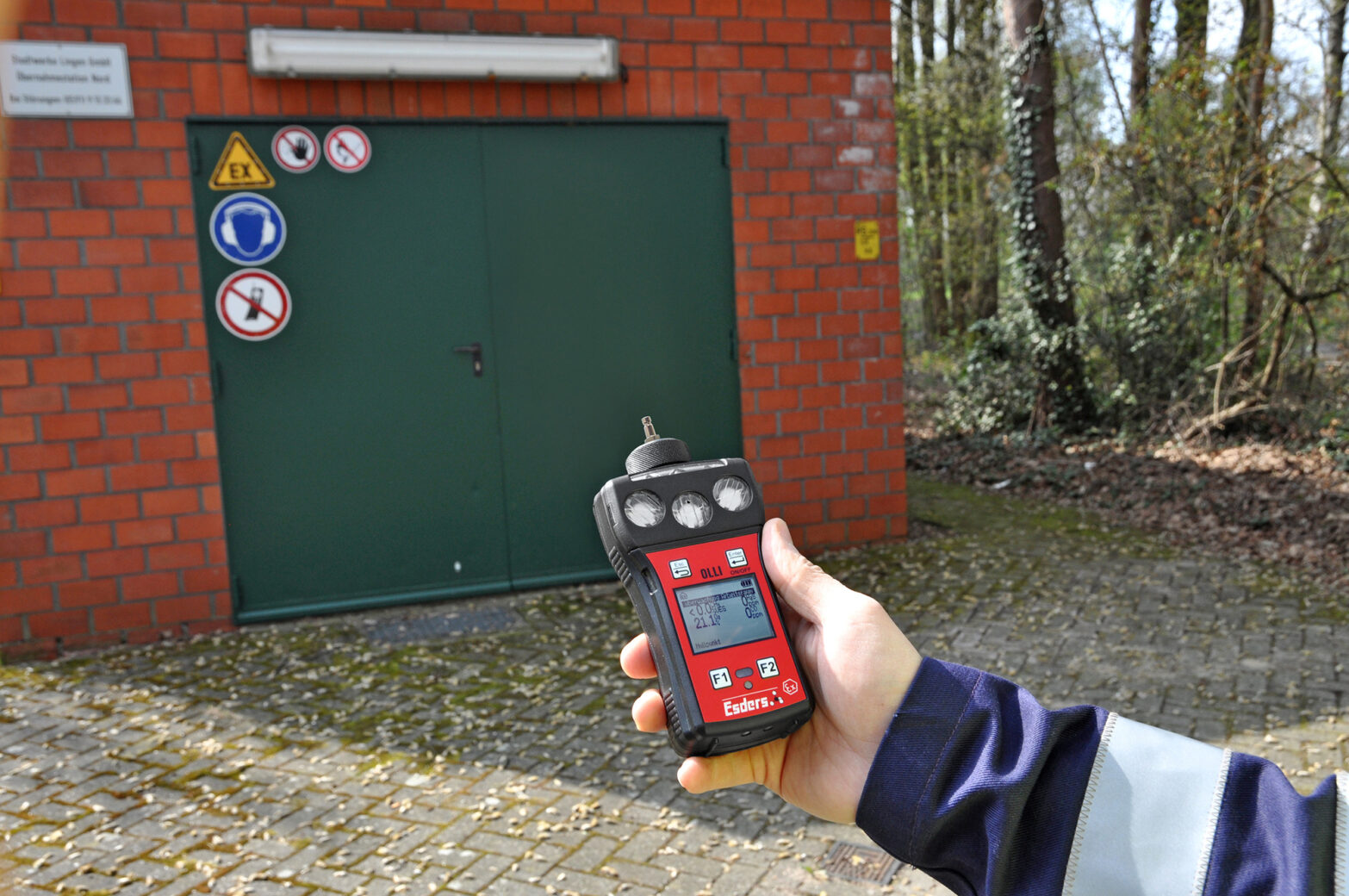
For atmospheric testing, the OLLI uses the menu item ‘Confined space entry‘. It can be started on the way to the site of the fault, once the quick gas test has been successfully carried out, as the sensors need some time to ‘stabilise‘. This may save valuable time at the site of the fault.

It is important that the ‘runs-in’ phase for the ‘Confined space entry‘ function is carried out in fresh air so that the sensors’ zero points can be set correctly and the measured values are not subsequently distorted.

If fresh air or clean ambient air cannot be guaranteed inside the fault-finding service vehicle, the ‘runs-in’ phase should only take place upon arrival at the location.

When conducting atmospheric testing with the OLLI, ensure that the gas inlet on the top of the device is free from dirt particles or similar obstructions and that the gas can flow through unhindered.

Furthermore, depending on the conditions on site, measurements should be taken at head height or above, as natural gas is lighter than air and therefore accumulates at the top, for example beneath the ceiling.

When carrying out atmospheric testing with an OLLI in the example configuration described, it makes no difference whether the gas is natural gas (L-gas or H-gas) or a mixture of hydrogen (H₂) and natural gas containing 20 vol.% H₂.

Once the fault location has been checked and it has been confirmed using a gas detector that there is no potentially explosive atmosphere and therefore no immediate danger, the source of the gas is usually located.

To do this, the ‘Building Inspection’ menu item in the OLLI is used, which demonstrates particular sensitivity in the lower measurement range at very low concentrations in the ppm range.

Before switching from ‘Confined space entry’ to ‘Building inspection’, it is again important to allow the sensor to stabilise in fresh air so that the zero point is set correctly. If the switch is made incorrectly whilst directly inside a gas-contaminated space, this may subsequently lead to incorrect estimations of the actual gas concentration present.

To avoid this, it is sufficient, for example, to position the measurement device by an open cellar window during the ‘Building inspection’ run-in phase.

The source of the gas leak can then be identified using the OLLI and an attached hand-held probe by ‘tracing’ the gas pipe.
The repair is only complete once the leak or leaks have been located and at least temporarily sealed. Any subsequent measures can then be carried out or planned.

Work safely with our OLLI, even when H2 is added

You can download our official information sheet on the suitability of our OLLI for gas networks with H₂ admixture here.

Gas detectors for confined space entry

OLLI function-tested
Gas measurement & warning device with certified measuring function for explosion protection. This variant of the OLLI is included in the BG RCI list of function-tested gas detectors (see item 280060 for the IIC version without certification). Explosion-proof & compact diffusion hand-held measuring device. It can be used for up to 5 combustible and toxic gases as well as oxygen and comes in an extremely rugged 2C synthetic housing with rechargeable and explosion-proof Li-ion battery pack. Charging the battery in potentially explosive atmospheres is not permitted! Up to 3 gas sensors can be installed (Ex/Ox/Tox). Assembly is based on customer requirements. The device can optionally be equipped with a pump and pressure sensor. Operating time > 50 hours (depending on type & number of installed sensors and ambient conditions, w/o illumination) Measurement ranges are subject to sensor assembly Dimensions: 136 x 78 x 43 mm Weight: approx. 350 g Explosion-proof measurement instrument (active & passive) Measuring function certified for methane (CH4), propane (C3H8), oxygen (O2), carbon monoxide (CO), carbon dioxide (CO2), hydrogen sulfide (H2S) according to the following standards: EN 60079-29-1 EN 50104 EN 45544-1 EN 45544-3 ATEX Marking: II 2G Ex ib db IIB T4 Gb (EU-)type examination certificates: BVS 17 ATEX E 043 X TÜV 21 ATEX 8596 X TÜV 21 PTG 7001 X 968/FSP 1940.05/21 Kennzeichnung IECEx: Ex ib db IIB T4 Gb IECEx BVS 21.0085X Temperature range: -20°C <= Ta <= +50°C
To the shop
OLLI
OLLI
Gas detection and gas warning device without certified measuring function for explosion protection. Compact diffusion hand-held measuring device for up to five combustible and toxic gases as well as oxygen in an extremely durable 2-component plastic housing with three alkaline manganese primary cells. Up to three gas sensors can be installed (Ex/Ox/Tox). The device can optionally be equipped with a Li-ion battery pack, pump and pressure measurement. The configuration is carried out individually according to customer requirements. Operating time > 50 hours (depending on the type and number of sensors installed and ambient conditions, without illumination) Measuring ranges depend on the sensors installed. Dimensions: 136 x 78 x 43 mm, Weight: approx. 350 g Explosion-proof measuring device, Marking (ATEX): II 2G Ex ib db IIC T4 Gb BVS 17 ATEX E 043 X Marking (IECEx): Ex ib db IIC T4 Gb IECEx BVS 21.0085X Temperature range: -20°C <= Ta <= +50°C
To the shop

Further information on atmospheric testing and personal safety

Blog tips

Blog

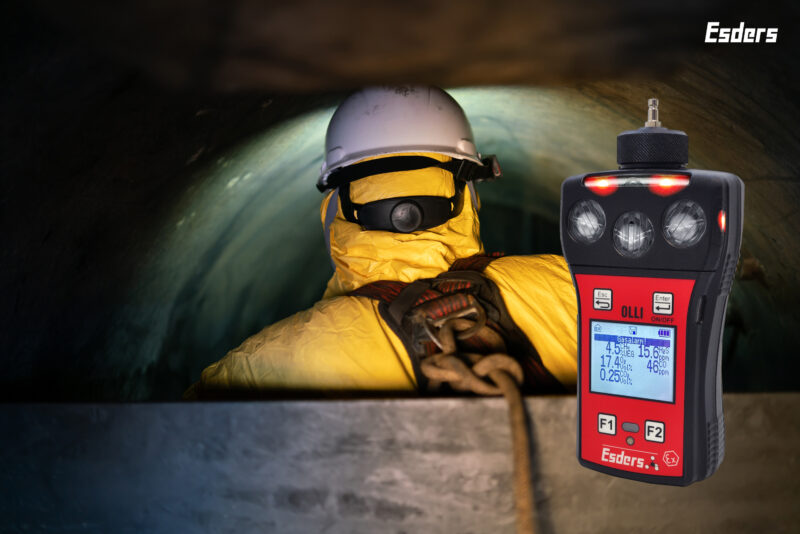
Our OLLI – multiple variants, one goal: measuring and testing for greater safety and efficiency

Whether gas, water or sewage networks: anyone responsible for critical infrastructure needs reliable and practical measurement technology. Our OLLI devices offer exactly that – in several specialised versions for different applications. Measuring and testing with our OLLIs: we present them in a practical and solution-oriented way. Safe shaft inspection and
Read more »
Blog

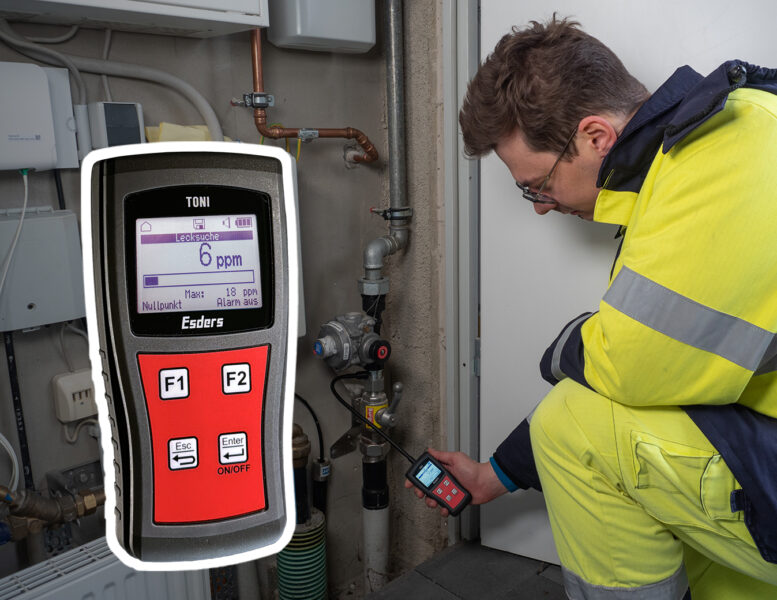
Ensure the safety of gas installations with TONI GasTest CH4

Gas installations are an indispensable part of a modern infrastructure. Regular maintenance of the systems is therefore necessary to ensure environmental and personal protection. Reliable equipment technology for gas leak detection is therefore the basis for a functioning process. The TONI GasTest CH4 offers a solution for precise methane leak

Read more »
Toxische Gase Personenschutz Freimessen mit OLLI
Blog

Personal protection: Oxygen (Ox) and toxic gases (Tox)

Table of Contents Oxygen (Ox) is, along with nitrogen, the main component of unpolluted ambient air in near-ground layers of the atmosphere and is necessary for the respiration of living organisms. It is thus one of the foundations of our lives. The oxygen content of the air is about 20.9

Read more »

Would you like to have a consultation with one of our experts or see a live demonstration of Esders devices?

We would be happy to answer any questions regarding confined space gas detection, atmospheric testing or suitable measuring devices.

Simply leave your contact details and we’ll get back to you as soon as possible.

Request a consultation

Would you like to know which device is right for your application? Get in touch with us: we’ll offer you personalised advice, with no obligation.

Request a live demonstration

You decide whether it’s in person or online: together, we’ll find a suitable time for a product demonstration.

Newsletter

Don’t miss out on the latest news about our technologies and key regulations – sign up for the newsletter now.
keyboard_arrow_up