
All testing options for gas installations with the TONI FlowTest
When it comes to gas installations, the question isn’t simply: Is it leak-tight or not? Depending on whether you’re inspecting an existing system, performing a repair, replacing a gas meter, or commissioning a new installation, different tests are required.
Leakage rates, pressures, and pressure curves can provide important insights into the condition of a system. However, correctly interpreting the measured values is just as crucial. For example, a serviceability test has a different objective than a leak test or a load test. The focus here is on DVGW Worksheet G 600 and DVGW-TRGI 2008 (Germany).
So what is tested, and when? What role does leak rate measurement play? And why can the measurement method and the layout of the system make a significant difference, especially in larger gas installations?
Operational Suitability of Gas Installations: More Than Just a Measurement
For existing gas installations, the condition of the piping system must be assessed regularly. This includes, among other things, the serviceability test. It is scheduled every twelve years and, in addition to assessing the general condition, also involves determining the existing leak rate.
The leak rate provides a specific measurement in liters per hour. It describes the volume of gas flowing through the piping. If all consumption units are shut off, this method allows you to determine the volume of gas escaping through leaks.
Tes the conditions
However, it is important to note that the measured value alone does not determine the condition of the system. A qualified technician must also inspect and assess the external condition of the gas installation as well as the exhaust gas path. If further defects are identified during this process, the entire system must be evaluated based on the worst rating from the individual tests—even if the measured leakage rate initially suggests the system is serviceable.
How is the leak rate evaluated?
For systems with an operating pressure up to 30 mbar, the determined leak rate is referenced to a reference operating pressure of 23 mbar. The system is then classified into three categories:
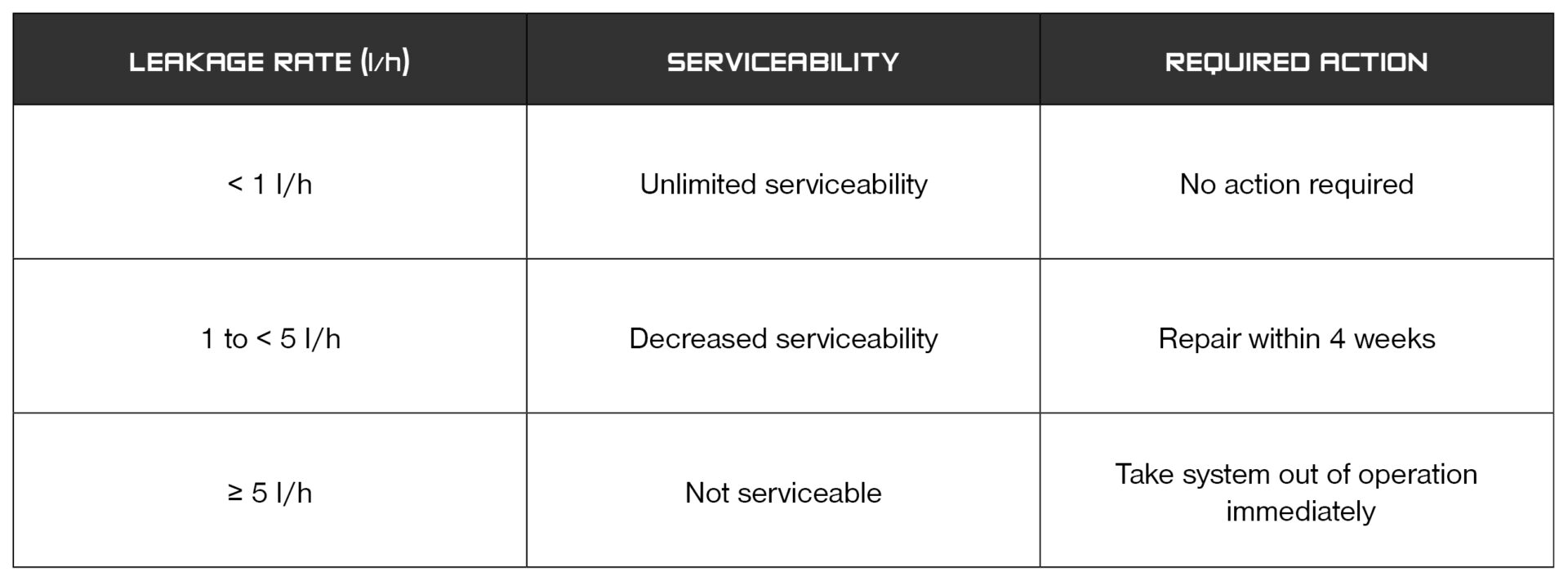
Regarding systems with an operating pressure exceeding 30 mbar, the corresponding leakage rate limits apply based on the actual operating pressure. The overall assessment remains the responsibility of qualified personnel.
Leak Rate Measurement: How Do the Measurement Methods Differ?
Various measurement principles are available for determining a gas leak rate. The decisive factor is how the resulting leak rate value is calculated.
Class D
In a Class D method, for example, the change in pressure within a known pipe volume is measured. A leak rate can then be determined from the pressure readings taken at different times. However, external factors such as temperature fluctuations can significantly affect the pressure curve and complicate the measurement conditions.
Class V
Concerning the Class V method, on the other hand, a known volume of gas is fed into the system from a buffer. The resulting change in pressure allows one to infer the volume of the entire system. However, if there is a leak with a leak rate greater than the volume supplied, this method reaches its limits. In this case, the system pressure cannot be maintained.
Class L
The Class L method works differently. Here, the gas flow rate is measured directly. Mass flow sensors are typically used for this purpose. This eliminates the need to first calculate the leak rate based on pressure changes and pipeline volume. In particular, it avoids the influence of temperature, which is a significant factor in pressure drop methods. In addition, even larger leaks can be detected, since the method is not limited by the size of a buffer volume.
What tests can be performed with the TONI FlowTest?
The TONI FlowTest determines leak rates using the Class L method. It measures the mass flow rate at operating pressure and displays the determined gas volume directly in liters per hour. The measurement range for leak rate determination is 0 to 8 l/h, with a resolution of 0.1 l/h. In addition, the system pressure is measured, allowing the relevant leak rate to be automatically normalized to the standard reference operating pressure (23 mbar).
In addition to leak rate measurement, further tests on gas installations can be performed using the appropriate accessories. These include, among others, serviceability, leak, and stress tests.
1. Determining the Leak Rate During the Serviceability Test of a Consumer Line
To measure the leak rate in a consumer line, the measuring device can be used in place of the gas meter. To do this, a corresponding test cap is installed and the measuring device is connected.
The actual gas flow rate at operating pressure is then determined. Put simply, the measuring device functions as a gas meter with very high resolution.
As the test procedure is menu-driven, it ensures that the individual steps and the required measurement times are carried out in a traceable manner, and the result is subsequently documented.
This type of leak rate measurement is particularly useful, for example, during periodic inspections or when replacing a meter. Instead of merely detecting a change in pressure, the process yields a concrete value: How many liters of gas per hour actually flow through the tested line?
2. Determining Leak Rates During Serviceability Testing of Riser Pipes
It is not always necessary to examine the entire gas installation at once. Especially with larger systems, it can make sense to test individual pipe sections separately.
For example, a riser can be supplied via an external gas source and a manual feed device. In installations with a single-pipe regulator, the regulator’s gas path can be isolated on the outlet side using a regulator shutoff valve. Subsequently, either a single section or the entire piping system can be tested.
This can be particularly advantageous in extensively branched installations: The smaller the pipe volume being tested during a measurement, the shorter the required adjustment and measurement times can be.
Why Pipe Volume Affects Testing Time
Large gas installations pose a particular challenge when measuring leak rates. The larger the pipe volume, the longer it takes for the system to reach stable conditions necessary for a meaningful measurement. The DVGW Worksheet G 600, DVGW-TRGI 2008, and Test Specification G 5952 also set specific requirements for test times.
Consequently, the specified stabilization and measurement times increase:
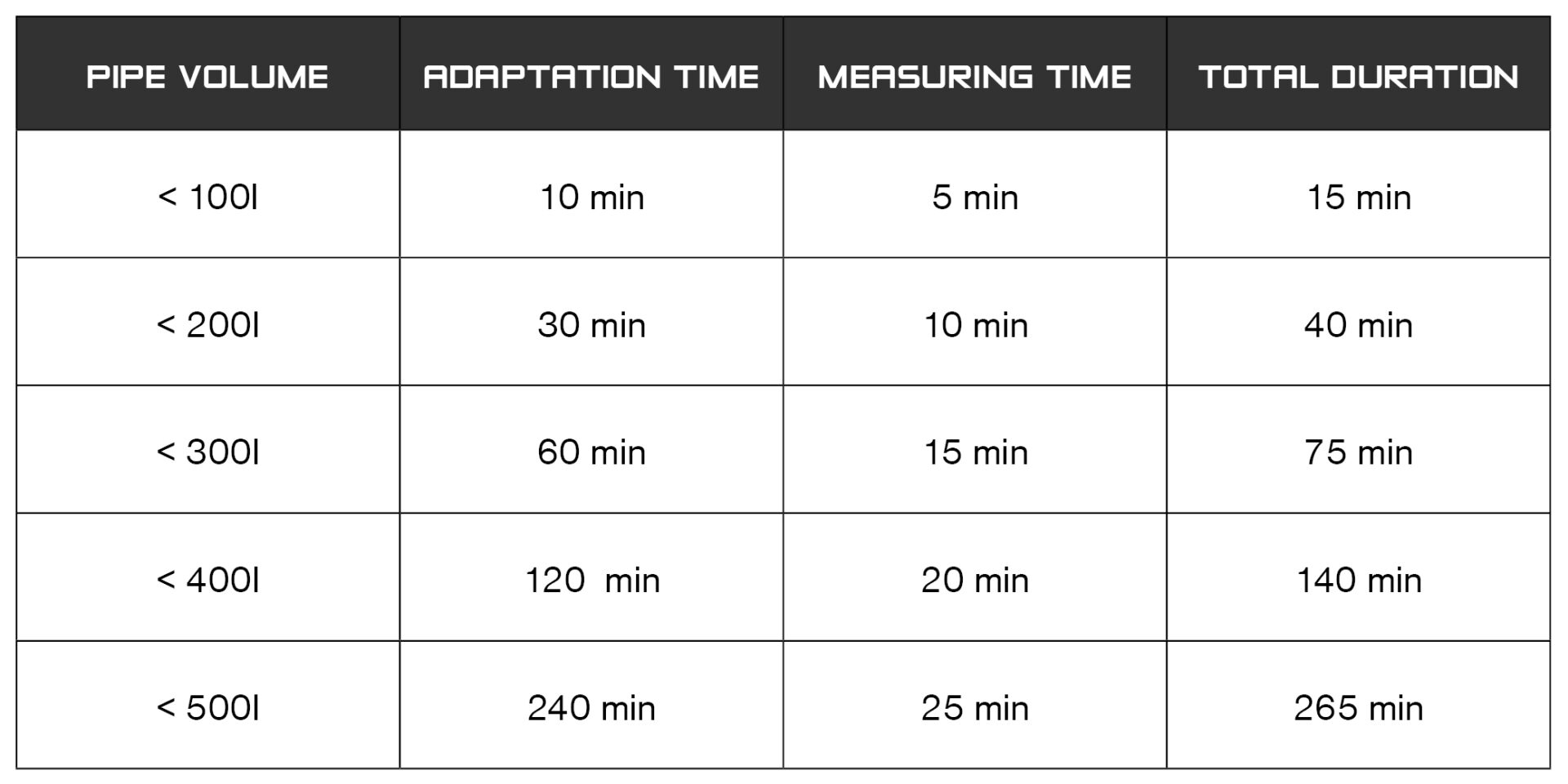
When it comes to larger systems, it is therefore worthwhile to take a close look at the system’s layout before beginning the measurement. If the system can be sensibly divided into individual test sections, this can significantly reduce the total test time.
There is also another factor to consider: The longer a measurement takes, the greater the likelihood that external conditions will change. Temperature fluctuations, sunlight, or drafts, for example, can influence the course of a measurement. Smaller test sections can help minimize such influences.
3. Leak Test After Work on the Gas Installation
If a gas installation has been repaired or modified, simply measuring the leak rate is not sufficient. A leak test in accordance with TRGI is required afterward.
During the leak test, the piping system—excluding certain fittings such as the regulator—is pressurized to a test pressure of 150 mbar. The pressure must not drop during the specified measurement period. The required resolution of the measuring instrument is 0.1 mbar.
Here, too, the DVGW Worksheet G 600, DVGW-TRGI specifies the measurement time based on the pipe volume:
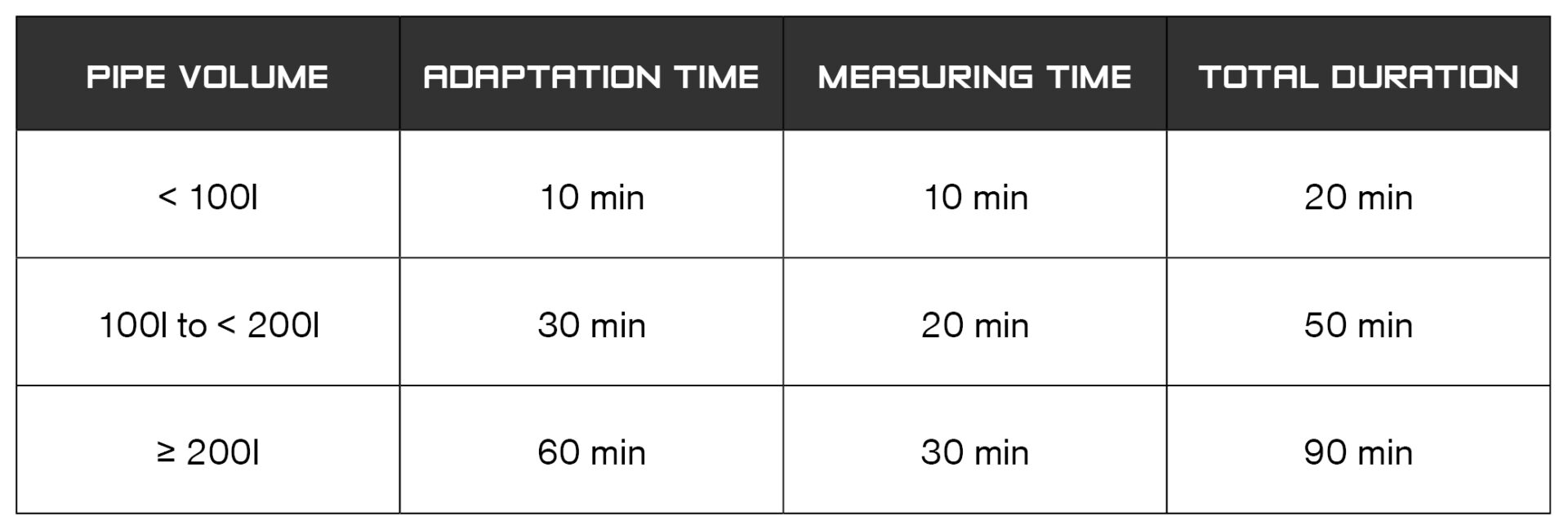
If the installation can be divided into logically separate sections, the total time required for this test can also be reduced.
With the appropriate pressure test option, the TONI FlowTest guides you through the test procedure and documents the result directly.
4. Load Test Before Commissioning
For newly installed gas systems, an additional test is required: the load test.
It is performed before the leak test and serves to check the piping system for strength and pressure resistance. Air is used as the test medium. Gas meters, regulators, and gas appliances are not part of the system being tested during the test and must be protected from high pressures.
The system is pressurized to a test pressure of 1,000 mbar or 1 bar. The pressure must not drop during a test period of ten minutes. Only then is the leak test performed.
Both tests—the pressure test and the leak test—can be performed and documented using the corresponding TRGI pressure test option in the TONI FlowTest software, guided by a menu.
5. Regulator Test: Don’t Just Focus on the Pipe
Depending on the job, assessing a gas installation also includes inspecting the gas pressure regulator. This involves checking several functions and pressure conditions.
With the appropriate add-on option, the following test points, among others, can be covered during a regulator test:
- Output pressure
- Closing pressure
- Tight seal of the gas pressure regulator
- Gas shortage protection
- Activation pressure of the safety relief valve (SRV)
- Tight seal of the SBV
- Upper and lower shut-off of the safety shut-off valve (SAV)
- Leak-tight seal of the SAV
This allows not only the actual line test but also important pressure regulation functions to be checked as part of a single, standardized test procedure.
.jpg?width=100)
Measurement and documentation go hand in hand
A measurement result is particularly helpful when it can be clearly linked to a specific system and a test that was performed.
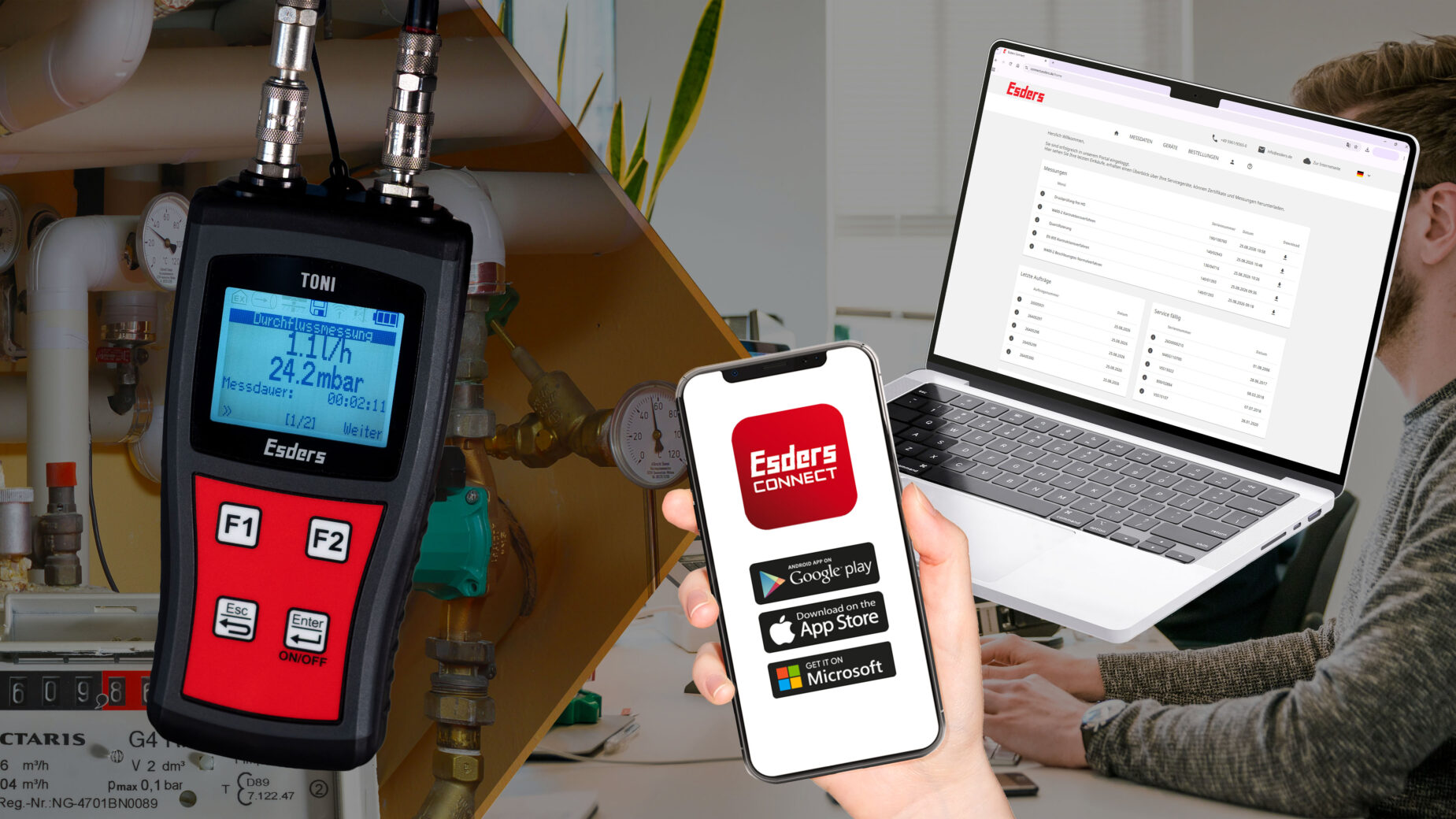
That’s why documentation is just as much a part of the test procedure as the actual measurement. With the TONI FlowTest, measurements are digitally recorded and stored. Additional input options allow you to link further details about the measurement location or the job directly to the measurement data. You can process the measurements and data further via Esders Connect.
Esders Connect is a web-based platform with an accompanying app, serving as the digital link between your measuring devices and the office. It enables centralized, digital management of your measurement data and devices. This automates your documentation processes and saves you valuable work time.
Automatic data backup to make work easier
This transforms the measured value into a traceable test record. This reduces the effort required—especially for recurring tests—to transfer results from handwritten notes or assign them to individual systems.
Digital documentation is also a fundamental part of the TONI device platform’s design. Depending on the application, the TONI family offers various devices for flow measurements, pressure tests, and gas leak detection that record measurement data. This data can then be accessed at any time in Esders Connect.
FAQs: Good to Know
Here we’ve compiled some common questions and answers regarding leak rate measurement and testing of gas installations for you.
What is a serviceability inspection of a gas installation?
A serviceability test assesses the condition of an existing gas installation. This includes a visual inspection of the system, a check of the exhaust gas routing, and the measurement of any potential leak rate. To evaluate the system, the leak rate (in liters per hour) is considered in direct relation to the overall condition of the installation. The final assessment must be based on the worst individual result.
How often must a serviceability inspection be performed?
For gas installations, a serviceability test is required every twelve years. Regardless of this, tests may also be necessary due to work performed on the installation, identified abnormalities, or other circumstances
What does a leak rate of 1 l/h or 5 l/h mean?
If the leak rate is less than 1 l/h, the system is considered fully serviceable. If the leak rate is between 1 l/h and less than 5 l/h, serviceability is reduced and repairs are required. At 5 l/h or higher, the system is considered unserviceable and must be taken out of service immediately. In addition, the overall condition of the installation must always be taken into account.
For gas installations with operating pressures below 30 mbar, the leak rate is referenced to a reference operating pressure of 23 mbar. This conversion no longer applies at operating pressures of 30 mbar or higher.
What is the difference between a serviceability test and a leak test?
The load test is used exclusively for new installations to verify the strength of the piping system. It is performed with air at a test pressure of 1 bar. This is followed by a leak test at a lower test pressure of 150 mbar.
Why is a Class L measurement particularly suitable for determining leak rates?
In Class L measurements, the gas flow rate is measured directly. This eliminates the need to calculate the leak rate from a pressure difference and a known pipe volume. In particular, this reduces the influence of temperature fluctuations, which can play a greater role in pressure-based methods. .
Can large gas systems also be tested for leak rates?
Yes, because the TONI FlowTest has no limitations regarding typical system volumes. However, as the pipe volume increases, the required adjustment and measurement times also increase. For large or extensively branched systems, it may therefore be advisable to test individual pipe sections separately. This can shorten the testing time and reduce external influences on the measurement.
What types of tests can the TONI FlowTest perform?
The TONI FlowTest is primarily designed for flow and leak rate measurements as well as serviceability tests. With the appropriate add-on options, it can also perform leak and load tests in accordance with TRGI, as well as tests on gas pressure regulators, and digitally document the results.