
Menu

Tracer gas: Leak detection using forming gas in pipework systems

Pinpointing leaks with precision when conventional methods reach their limits

Leaking water pipes cause water wastage, costs and, frequently, costly consequential damage. Tracer gas can be used to pinpoint even small and concealed leaks. This method is not only suitable for water pipes laid underground or within buildings, but also for heating and cooling systems, flat roofs, engine compartments in various vehicles and more.

What challenges do you face when detecting leaks?

Sometimes the leak is not where the damage is visible.

In the tracer gas method, a gas mixture is fed into the pipework system to be inspected. Forming gas typically consists of 5 vol.% hydrogen and 95 vol.% nitrogen. This mixture is non-flammable and is therefore suitable for safe leak detection.

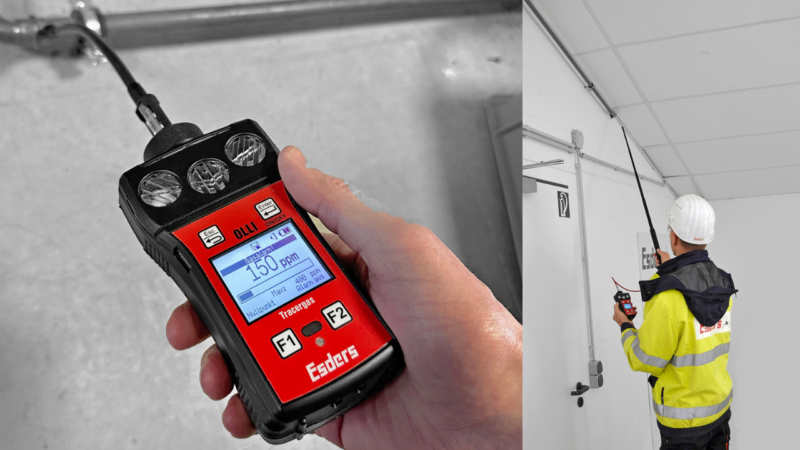
Due to its very small molecular size, the hydrogen escapes even through very small leaks. Using a gas detector calibrated for hydrogen and the appropriate probe, the escaping foming gas can then be detected and the leak location pinpointed.

Preliminary detection and precise localisation

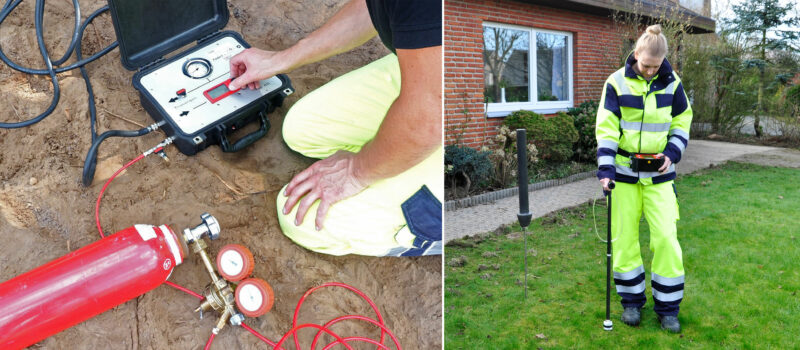
In the case of underground pipes, the initial step is to locate the pipe above ground, for example using a carpet or bell probe. Once tracer gas has been detected, the area can then be narrowed down further.
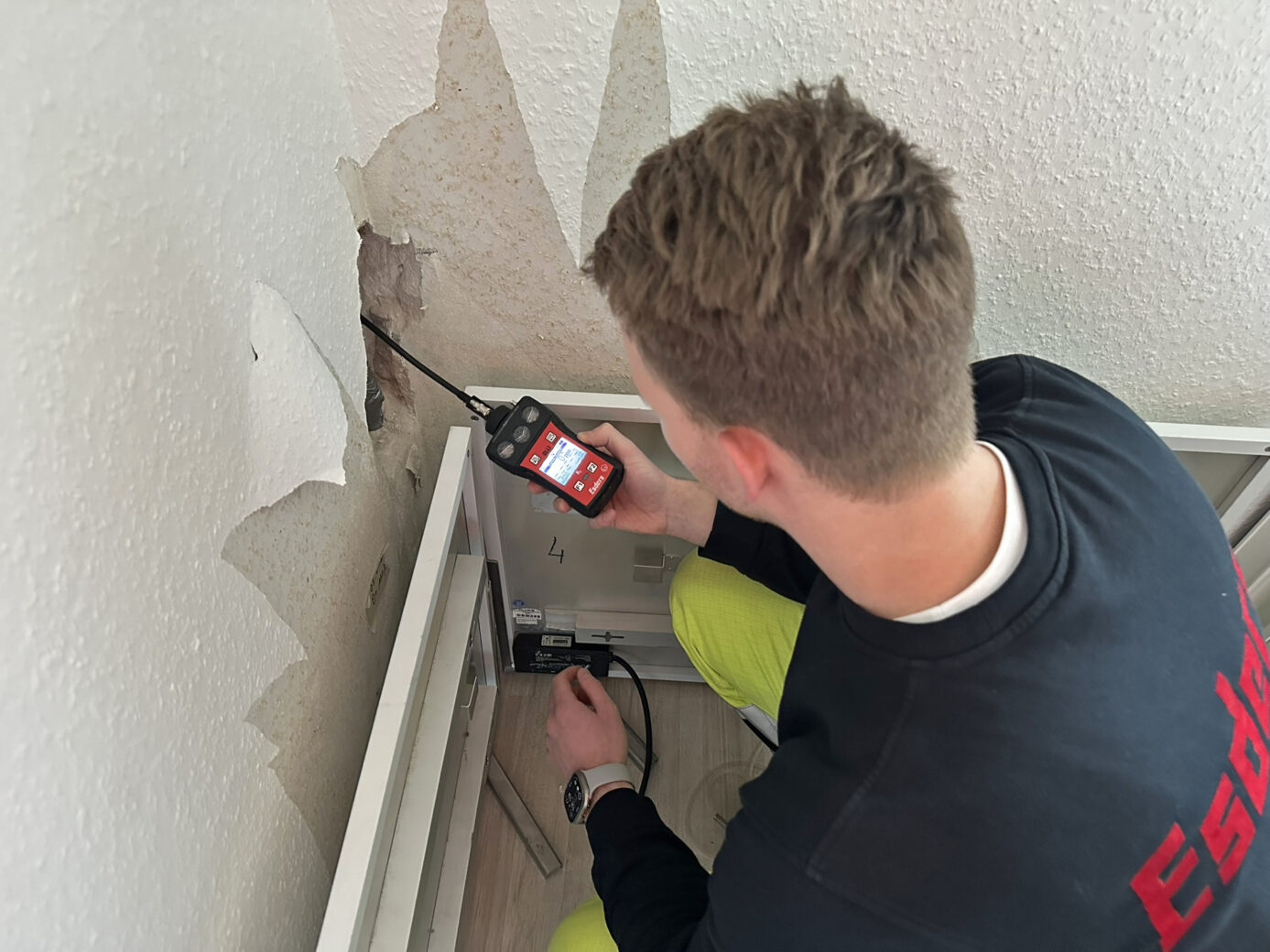
The method can also be used effectively indoors. Hydrogen can diffuse through screed, joints and the tiniest of openings, thereby providing indications of concealed leaks.

Practical examples of the use of forming gas in leak detection

The forming gas method is suitable for a range of applications, particularly where pipes are not directly accessible or where other location methods do not provide clear results. In our case studies, we demonstrate exactly how leak detection using tracer gas works.

Leak detection using tracer gas in indoor pipework

Detección de una fuga de agua en interiores con HUNTER Tracergas

No unnecessary demolition and precise location of leaks thanks to tracer gas

At the Haseluenne shooting club, visible water damage suddenly appeared on several interior walls. The first signs of mould were already visible. It quickly became clear that there was most likely a leak in the drinking water system.

The challenge: the exact route of the pipes in the old building is not clearly documented. The pipes in the shooting club run beneath the floor, under the screed and insulation. Only a small number of replacement tiles are available. Opening up a large section of the floor would therefore not only incur high costs but also damage the building structure.

Instead of starting work “on a hunch”, it was therefore decided to carry out a leak detection using tracer gas (forming gas) that would minimise damage to the building materials.

The HUNTER Tracer Gas was used for this purpose.

Why traditional leak detection methods failed

In many cases, leak detection is initially carried out using acoustic methods. This approach was also considered in the case of the Haseluenne shooting club. However, the water pipes were located beneath polystyrene insulation, which absorbed sound to a great extent.

A thermographic inspection was also unsuccessful, as the medium in the pipe was almost the same temperature as the surrounding floor. This means that without a temperature difference, a thermal imaging camera cannot provide reliable indications.

Particularly with insulated floor structures, experience has consistently shown that when acoustic leak detection is not possible, tracer gas method offers a reliable alternative.

Leak detection procedure using forming gas

Inyección de gas trazador a la red de agua
Step 1

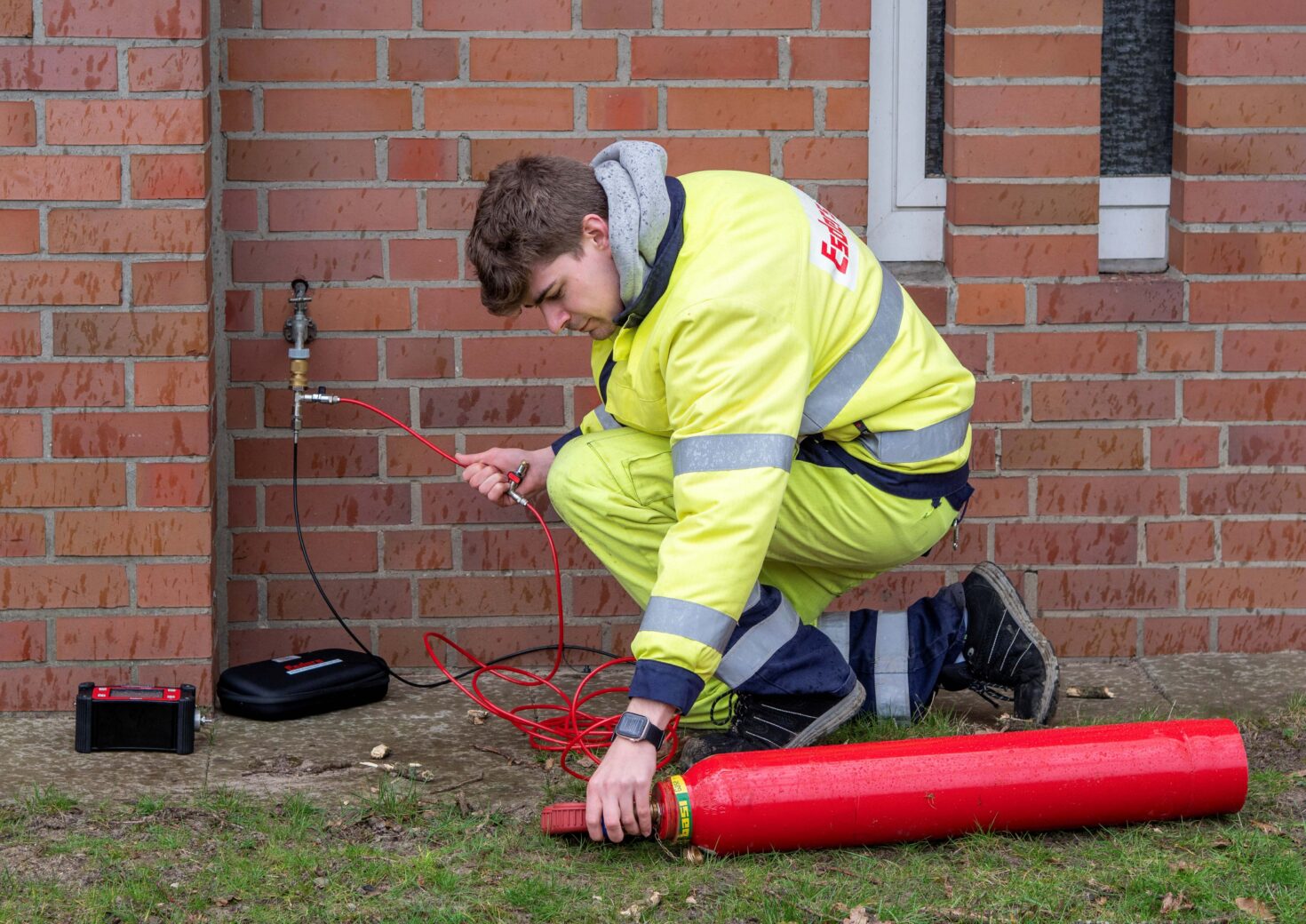
First, the forming gas (a mixture of 5% by volume of hydrogen and 95% by volume of nitrogen) was fed into the affected pipe via an external valve. It was crucial to feed the gas as close as possible to the suspected site of damage to allow rapid diffusion.

After the gas was introduced into the pipe, a waiting period of about 30 minutes was observed. This is the time required for the hydrogen to spread through the screed, joints, and even the smallest cracks and escape to the surface. This is the major advantage of the tracer gas method: hydrogen, being the smallest and lightest atom, rises to the top and escapes even through the tiniest cracks.

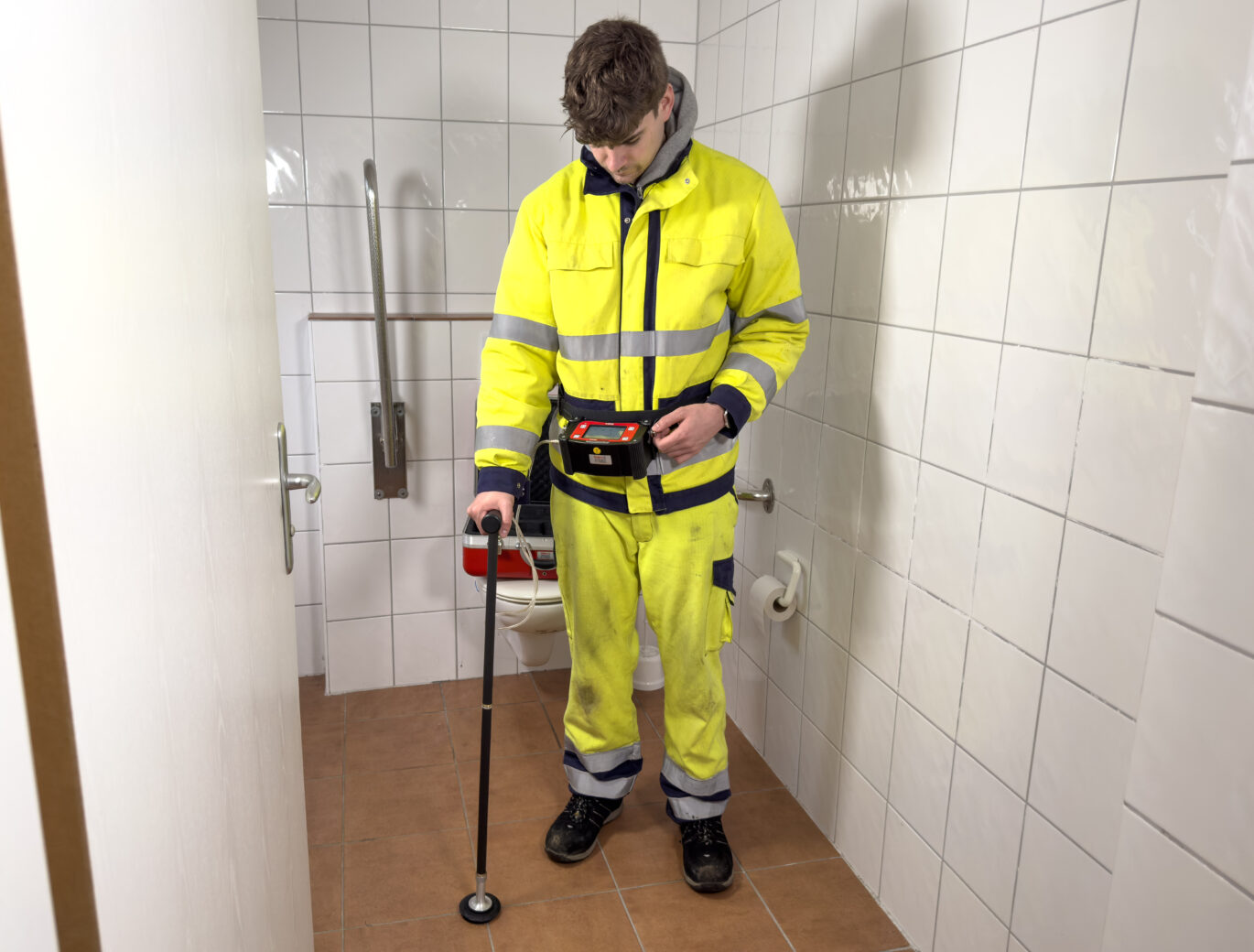
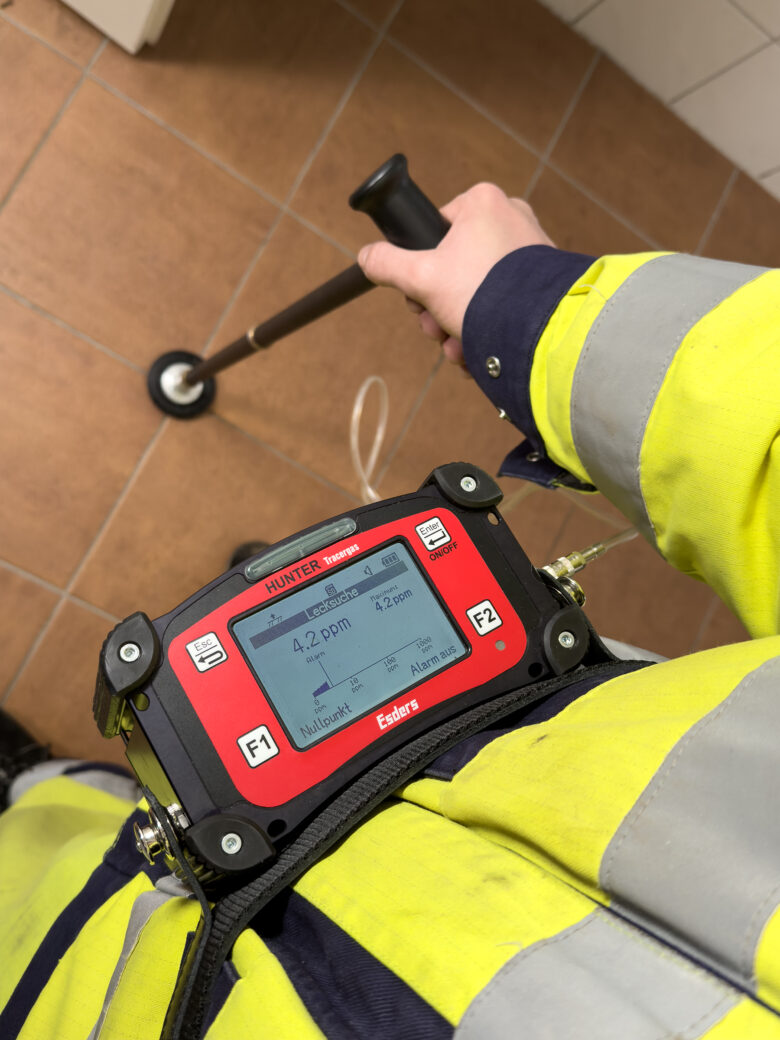
The actual leak detection was then carried out systematically using the bell probe. We deliberately avoided measuring directly on the tiles and instead focused on the joints, since gas diffuses much more quickly through joint compound than through fired tiles.

As soon as the first readings in the ppm range became visible, the process of narrowing down the location began. By drilling small, targeted holes in the joints, the gas concentration could be further checked. The higher the measured value, the closer you are to the actual leak.

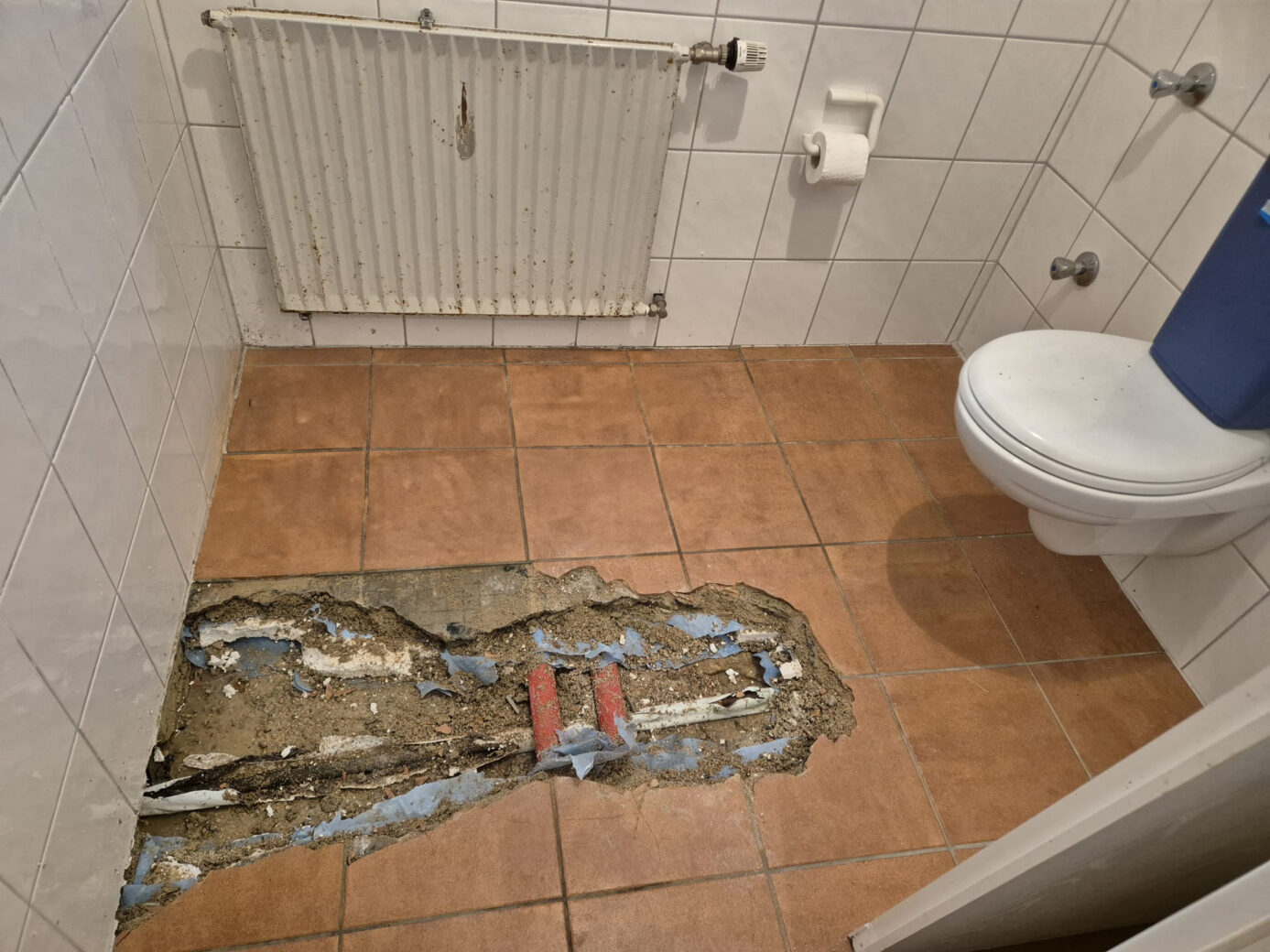
This allowed the damaged area to be narrowed down to approximately 40 x 40 cm. The localized leak was ultimately found to be about 2.5 meters away from the visible damage – that is, the damp spot on the wall.

Advantages of tracer gas method for hidden pipe leaks

Forming gas is harmless to humans and the environment: it is non-flammable, non-explosive, and non-toxic. In practice, however, one property is particularly crucial: the high diffusivity of hydrogen.

This property really comes into its own with concealed pipes in the ground or under screed structures. While acoustic methods are highly dependent on material composition, tracer gas works regardless of temperature differences or sound transmission.

For plumbing and heating companies as well as leak detection services, this means an additional and highly precise tool in their toolkit, offering several advantages for the service provider, the customer, and, in most cases, the insurance company as well.

HUNTER Tracergas siendo utilizado para detectar una fuga de agua subterránea

Benefits for service providers and specialized contractors

The use of HUNTER Tracer Gas and OLLI Tracer Gas offers several practical advantages in day-to-day work. The device responds quickly to changes in concentration and features an integrated pump, allowing for flexible use of various probes. This makes it suitable for both concealed indoor pipes and exposed components.

  • Leak detection even at very low leak rates
  • Use in drinking water, heating, or cooling systems
  • Independence from temperature differences
  • Minimally invasive localization instead of extensive demolition

Precise leak detection not only increases customer satisfaction but also reduces disputes with insurance companies and minimizes repair costs and associated expenses.

Do you have questions about leak detection technologies using tracer gas?

Simply fill out the form below to receive expert advice from our specialists.

Results: minimal damage, maximum precision

The leak was clearly identified. Instead of opening up the entire floor area, only a clearly defined section needed to be exposed.

This significantly reduced the cost of repair and restoration and prevented further damage caused by persistent moisture and mold growth.

When is leak detection using tracer gas method recommended?

In practice, the tracer gas method is particularly useful:

  • when pressure tests only confirm a leak but do not allow for precise localization
  • when acoustic methods are not sensitive enough due to insulation or material composition
  • for small leak rates
  • for concealed installations in the ground or under screed

Good preparation is key: having as accurate a picture as possible of the pipe layout helps to inject the gas precisely and conduct the search efficiently.

Related products

OLLI Tracer Gas
OLLI Tracer Gas
Portable gas leak detector with integrated pump, wireless data transfer and Li-Ion battery for leak detection using forming gas (5% H2 in 95% N2). Extremely resistant 2K plastic housing Operating time > 35 hours (depending on ambient conditions, without lighting) Pump flow approx. 20 l/h Dimensions (LxWxH): 170 x 80 x 43 mm, Weight: approx. 380 g
To the shop
HUNTER Tracer Gas
HUNTER Tracer Gas
Gas detection device for easily locating even the smallest leaks in pipes using forming gas (5 Vol.% H2 in N2) - highly sensitive hydrogen sensor with a resolution of 0,1 ppm H2 - extremely fast reaction to the smallest traces of hydrogen - second sensor for pinpointing in probe holes - integrated pump with high power for flow and for negative pressure Operation time: > 10 hours without lighting Measuring ranges: 0 to 1000 ppm H2 0 to 5 Vol.% H2 in N2 dimensions: approx. 200 x 100 x 87 mm weight: approx. 1100 g
To the shop

Further reading

Blog tips

Lecksuche mit HUNTER H2 und Formiergas
Blog

Tracer Gas Leak Detection for Water Pipes: How the Method Works

Table of Contents Water is a scarce and therefore precious resource that must be protected with all available methods. This means that leaks in drinking water distribution systems (DWDS) must be found quickly in order to minimise water losses. However, finding the exact location of a water leak is not

Read more »

Newsletter

Don’t miss out on any news about leak detection and leak localisation. Sign up for the newsletter now.

Consultation

Would you like to find out more about Esders, our technologies and, above all, the opportunities available to you? We’d be happy to advise you, with no obligation.

Live Demonstration

Find out more about our measuring equipment. Fill in the form below, and we’ll arrange a convenient time with you for a demonstration at your premises or online.
keyboard_arrow_up