

The series of information sheets G465-4-1 ff. (11/2025) describes the currently available detection technologies for gases that comply with DVGW worksheet G 260 (A), with the exception of liquefied gases in the vapour phase:
- for the detection of gas leaks in pipes and systems used for gas production, gas transport, gas distribution and gas installation, as well as in customer-owned systems and gas installations in industrial applications
- for the assessment of explosion hazards in work areas, and
- for the determination of specific gas components.
The use of instruments or measurement systems for the metrological quantification of methane emissions in accordance with the EU Regulation on methane emissions is not described in this information sheet, but in information sheets G 465-5, G 424 and G 425-1 ff. The extent to which these technologies are also suitable for detecting hydrogen is described in the supplementary technical notes G 465-4-2 ff.
For the inspection of installations and gas pipes that do not serve the public supply of gas, or for gases that do not comply with the provisions of DVGW G 260 (A), these technical guidelines may be applied accordingly, taking into account the specific properties of the gases and, where applicable, other existing regulations.
The DVGW information sheet series G 465-4-1 ff. (11/2025) replaces DVGW information sheet G 465-4 (05/2019).
Overview of sensors and their applications
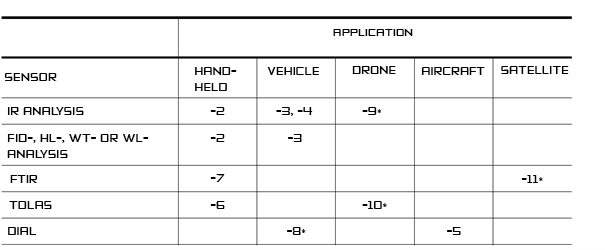
The numbers in the table refer to the relevant sub-guidelines of DVGW Guideline G 465-4-1 ff., in which the devices and systems, as well as their applications, are described in more detail. Systems marked with an * have not yet demonstrated operational reliability, and consequently have not yet been assigned sub-guidelines.
Overview of devices, applications and usage scenarios
The following lists devices currently available in accordance with the state of the art, along with specific characteristics relating to their applications and usage scenarios. Detailed system descriptions, requirements regarding detection characteristics and the procedure for verifying these requirements are set out in the respective sub-sheets.
G465-4-1 11_2025
General requirements
This information sheet applies to portable gas detection devices that comply with DVGW Worksheet G 260 – with the exception of liquefied gases in the liquid phase: for the detection of gas leaks in pipes and systems used for gas generation, gas transport, gas distribution and gas installation, as well as in customer-owned systems and gas installations in industrial applications; for the assessment of explosion hazards in work areas; and for the identification of specific gas components.
G465-4-2 11_2025
Handheld gas concentration measuring devices
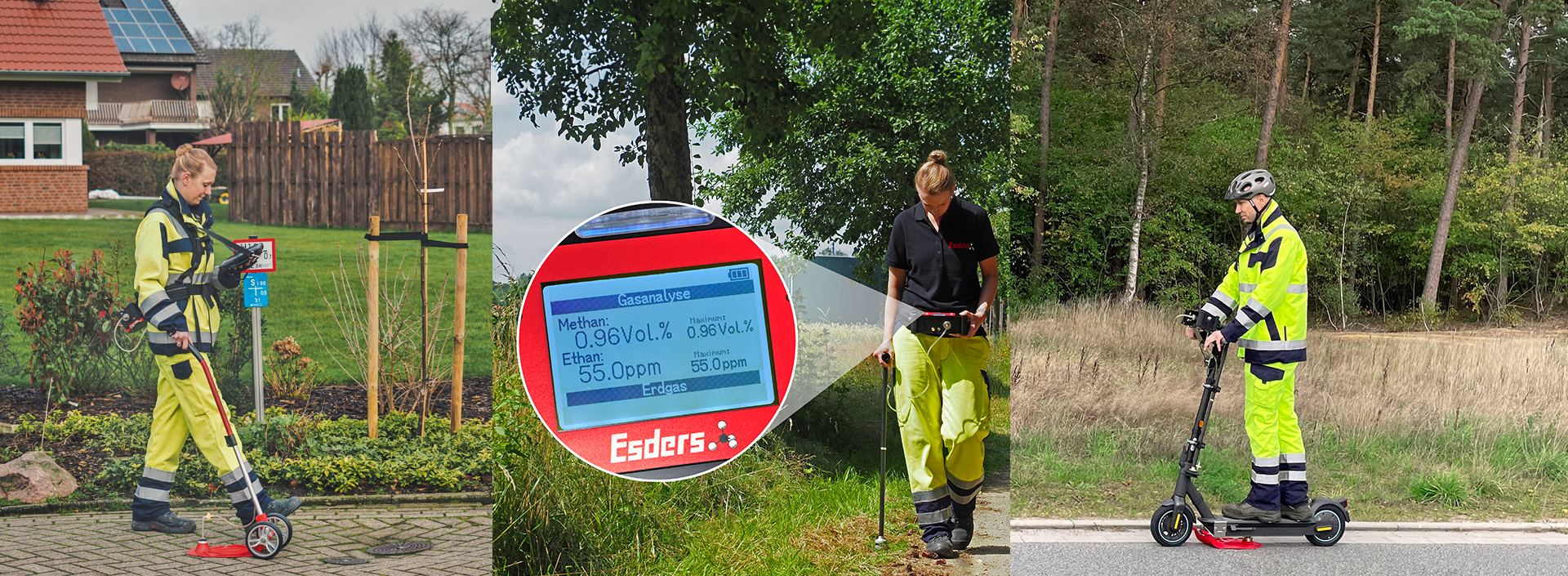
Handheld gas concentration measuring devices are used in conjunction with the appropriate probe technology. A wide variety of sensors and sensor combinations are incorporated into the devices to measure the components of the air.
The devices are tried and tested in practice; typical applications include: scheduled gas pipeline network inspections, the localisation and classification of gas leaks, as well as on-call duty or the monitoring of the workspace.
G465-4-3 11_2025
Vehicle-mounted systems for inspecting underground gas pipelines
In addition to traditional measurement methods based on semiconductor sensors and flame ionisation detectors, the detection of methane using optical methods – such as laser-based principles – has been increasingly developed in recent years. This technical note sets out requirements, test criteria and implementation guidelines for systems with a resolution in the ppb range. The vehicles inspect areas immediately above the pipeline; gas intake devices located close to the surface draw the atmosphere to be tested into the laser system.
Optionally, these vehicle-mounted measurement systems can also be used to inspect an area located next to the vehicle on the windward side of the carriageway, provided they have passed the necessary optional suitability test.
G465-4-4 11_2025
Vehicle-based systems for inspecting gas pipelines using atmospheric concentration and wind measurements
These gas detection vehicles are equipped with ppb-sensitive measurement technology for methane, and usually for ethane as well. They are also fitted with wind measurement technology. During several measurement runs along the routes of a predefined area, e.g. a district, the gas concentrations as well as the wind directions and speeds are recorded, so that an evaluation calculation can be used to identify the locations of potential gas leaks.
Such measurement systems are generally suitable for detecting methane mixtures with hydrogen up to 30% by volume. It should be noted, however, that the measurement systems primarily detect only methane and ethane (hydrogen is not detected).
G 465-4-5 11_2025
Airborne remote gas detection
This technical note specifies requirements and test criteria for remote gas detection methods integrated into aircraft (such as helicopters or aeroplanes) and used for aerial inspection of both underground and above-ground natural gas transmission pipelines within and outside built-up areas, as well as for methane detection at gas infrastructure facilities.
The use of airborne remote gas detection is restricted to pipelines with a current operating pressure of 5 bar and above.
G 465-4-6 11_2025
Hand-held laser devices with an open measuring path (TDLAS)
These laser devices measure/detect methane using actively emitted IR radiation. They are typically suitable for detecting methane mixtures with hydrogen up to 30% by volume. It should be noted that the devices only detect methane; the user must be aware of the hydrogen content in the gas. They are suitable for detecting gas leaks in pipelines and systems used for gas extraction, gas transport, gas distribution and gas installation, as well as in customer-owned systems and gas installations in industrial applications. Devices that have undergone specific suitability testing can also be used for inspecting underground pipelines in inaccessible areas as part of gas pipeline network inspections.
G465-4-7 11_2025
Imaging remote gas detection methods
Gas cameras (mobile or stationary) for the optical remote detection of methane in accordance with DVGW Worksheet G 260 for the 2nd gas family, “Methane-rich gases”.
The state of the art consists of infrared cameras that operate using imaging, passive methods and utilise infrared background radiation. Gas leaks are visualised. Find out more here.